
Is IV Therapy safe? Short answer: IV therapy is safe when a qualified clinician reviews your health history, your medications, and often your bloodwork first.
It becomes genuinely risky when it’s handed out like a menu item, with no assessment and no one accountable for what goes into your vein. That difference is the whole point of this article.
Someone reached out to us last week wanting an IV. They knew exactly which one. They had read about it, seen it work for someone online, and they were ready to book.
One thing they did not want was an intake. Just the drip, please. In and out.
We said no.

Saying yes, in that moment, would have meant putting something into their bloodstream without knowing whether it was safe for them, let alone right for them. And that is a line we do not cross.
I want to explain why, because I think most people have never been told what an IV actually is. Somewhere along the way, intravenous therapy started getting talked about like a smoothie.
Pick a flavour, grab a drip, feel better. That framing is everywhere right now, and I understand the appeal. But it leaves out the part that matters most.
What makes IV therapy safe (or not)
An IV is treatment. Whatever goes into the bag bypasses your digestive system entirely and goes straight into your circulation, at full strength, all at once.
That is exactly why IV therapy can be so effective. It is also exactly why it deserves real assessment first.
So when someone asks “is IV therapy safe?”, the honest answer is that safety is not a property of the drip itself. It is a property of the process around it.
The same bag of nutrients can be perfectly safe for one person and a real problem for another.
What separates the two is whether anyone looked before the needle went in.

The bloodwork problem
Here is the example I keep coming back to. A nutrient that is completely safe for most people can be a genuine problem for someone whose kidneys are not clearing the way they should, or whose heart is under strain, or whose iron status is the opposite of what they assumed.
These are not rare, dramatic conditions. They are common, and they are often quiet. A person can feel fine and still have a marker on their bloodwork that changes what belongs in their IV and what does not.
You cannot know that from how someone looks or what they tell you at the front desk. You know it from their history, their current medications, and in many cases their labs. That is the work that happens before the needle, and it is the work a no-intake model is built to skip.
This is why we treat “do I need bloodwork before IV therapy?” as a real clinical question rather than a formality. Sometimes the honest answer is yes, and that answer is the thing keeping you safe.

Can IV therapy be dangerous?
It can be, but it’s probably not what you think. The risk is not usually the nutrient being exotic or extreme. The risk is the mismatch: a normal ingredient meeting a body that, for reasons no one checked, cannot handle it the way most people can. Kidneys that are not filtering well. A heart under strain. An electrolyte or iron level sitting far from where someone assumed it was.
A drip given without assessment is not dangerous because the bag is sinister. It is dangerous because no one ruled out the situations where that bag does not belong. Assessment is how you find those situations before they become problems, not after.
Sometimes the safest answer is that you do not need one
There is a second reason we say no, and it surprises people. Sometimes, after we actually talk to someone, the honest answer is that an IV is not what they need. Maybe what is going on is better addressed another way. Maybe the symptom they are chasing has a cause an IV would not touch. We would rather tell you that than sell you a drip that makes us money and does nothing for you.
That conversation is not a sales obstacle we are working around. It is the entire point of seeing a clinician first.
An IV is part of a plan, not the whole plan
This is the part I most want people to understand. An IV on its own rarely fixes what brought you in. It can support you, replenish you, and give your body something it genuinely needs. But the reason you felt depleted, or run down, or off in the first place does not usually live in a single bag of nutrients. It lives in the fuller picture, and that is what we are assessing for.
When you come in for an intake, we are not just clearing you for an IV. We are figuring out where the IV fits within your care, and what else needs to happen alongside it for you to actually feel different. The IV is one piece. The plan around it is what makes the piece matter.
Giving someone the drip without the rest is like handing over one tool and calling it the whole repair.
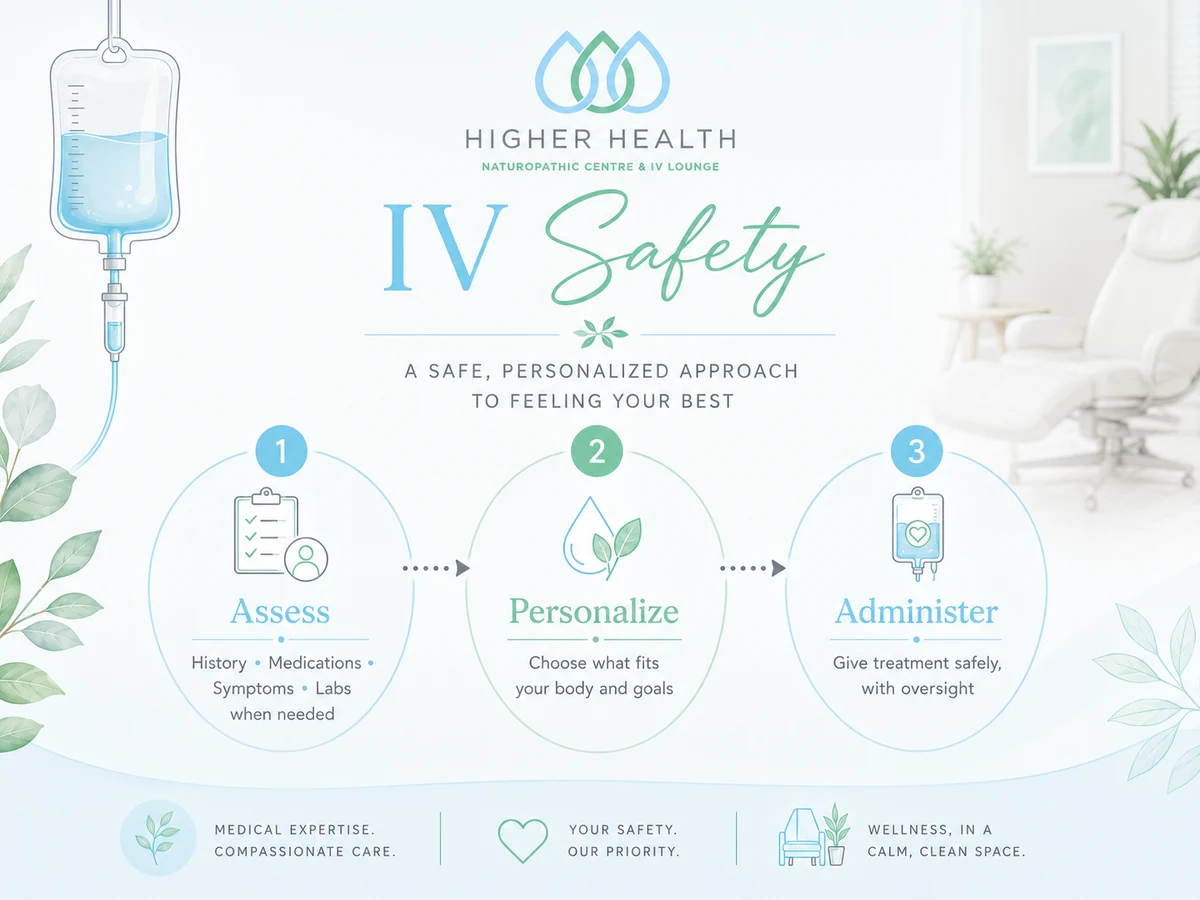
That is another reason we do not do IVs in isolation. Not because the rules say so, but because on its own, it is rarely enough.
What “oversight” actually means here
When people hear that IV therapy needs professional oversight, I think it sounds like paperwork. It is not. At Higher Health, IV therapy is assessed, prepared, and administered under naturopathic doctors who hold specific intravenous certification, Intravenous Infusion Therapy, alongside therapeutic prescribing authority.
The clinic itself is certified to prepare and administer intravenous therapy. There are real regulations governing how an IV is prepared, who can prescribe what goes in it, and how it is delivered to you safely.
That structure is not there to slow you down. It is there so that the person deciding what goes into your vein has done the training to make that decision, and is accountable for it.

What this means for you
If you are already a patient here, this is simply why your experience looks the way it does. The intake, the questions, the occasional “let us check something first” are not friction. They are the reason you can trust what you receive.
And if you are someone who is just starting to look into IV therapy, I would offer you one filter as you decide where to go. Ask who is assessing you before your IV, what their training is, and whether they would ever tell you no. A place that would never decline a request is telling you something about how they see this. We see it as treatment. So we treat it that way.
Frequently asked questions
Is IV therapy safe?
Yes, when it is assessed and administered by a qualified clinician who has reviewed your health history, your medications, and where appropriate your bloodwork. The drip goes straight into your circulation at full strength, so safety depends on someone confirming that what is in the bag is right for your body before it is given. It is far less safe when offered with no assessment and no clinical accountability.
Do I need bloodwork before IV therapy?
Often, yes. Bloodwork can reveal things you cannot feel, such as how well your kidneys are clearing, whether your heart is under strain, or where your iron and electrolyte levels actually sit. Any of these can change what belongs in your IV. Whether labs are required depends on what you are asking for and your health history, which is exactly what the intake is for.
Can IV therapy be dangerous?
It can be, if given without assessment. The risk usually is not the nutrient itself but the mismatch between a standard ingredient and a body that cannot handle it the way most people can. Proper screening before the IV is how that risk is identified and avoided.
Why would a clinic say no to an IV I asked for?
Because a responsible clinic treats IV therapy as medical treatment, not a retail product. Sometimes the assessment shows an IV is not safe or not the right fit, and sometimes it shows your concern is better addressed another way. A clinic willing to decline is one that is actually looking before it treats.
If you have questions about whether IV therapy is right for you, that is exactly the kind of conversation we are happy to have. You can book a free consultation to speak with an IV certified naturopathic doctor.
References:
https://health.clevelandclinic.org/iv-vitamin-therapy
Related at Higher Health: See our full IV drip therapy menu, or take our free IV therapy assessment to find the right drip for you.
Last Updated on Thursday, July 16, 2026
The Vitamin D Conversation I’d Rather Have Now Than in January
Does IV Therapy Work? Here’s When It May Make Sense
Perimenopause and IV Therapy: What the Research Really Shows
