
The backpacks are back. The mornings are cooler. Vacations are ending. And somehow, September is already here.
Summer is winding down, the days are getting shorter, and most of us are about to spend a lot more time indoors.
For those of us living in Canada, that also means our bodies may start making less vitamin D from the sun.
So before Thanksgiving arrives, everyone around you starts coughing, and you’re wondering why you already feel run down, September is a good time to think about your vitamin D.
This is one of those conversations I would much rather have with a patient now than in January.
Vitamin D Does More Than Help Your Bones
Most people know vitamin D is important for strong bones.
It is.
But vitamin D also helps our muscles work properly and plays an important role in how our immune system works.
And when we look at the research, something stands out:
Being low in vitamin D may matter when it comes to respiratory infections.
One review pooled 14 studies covering more than 78,000 people. Those with the lowest vitamin D levels had 83% higher odds of an acute respiratory infection compared with those with the highest levels.
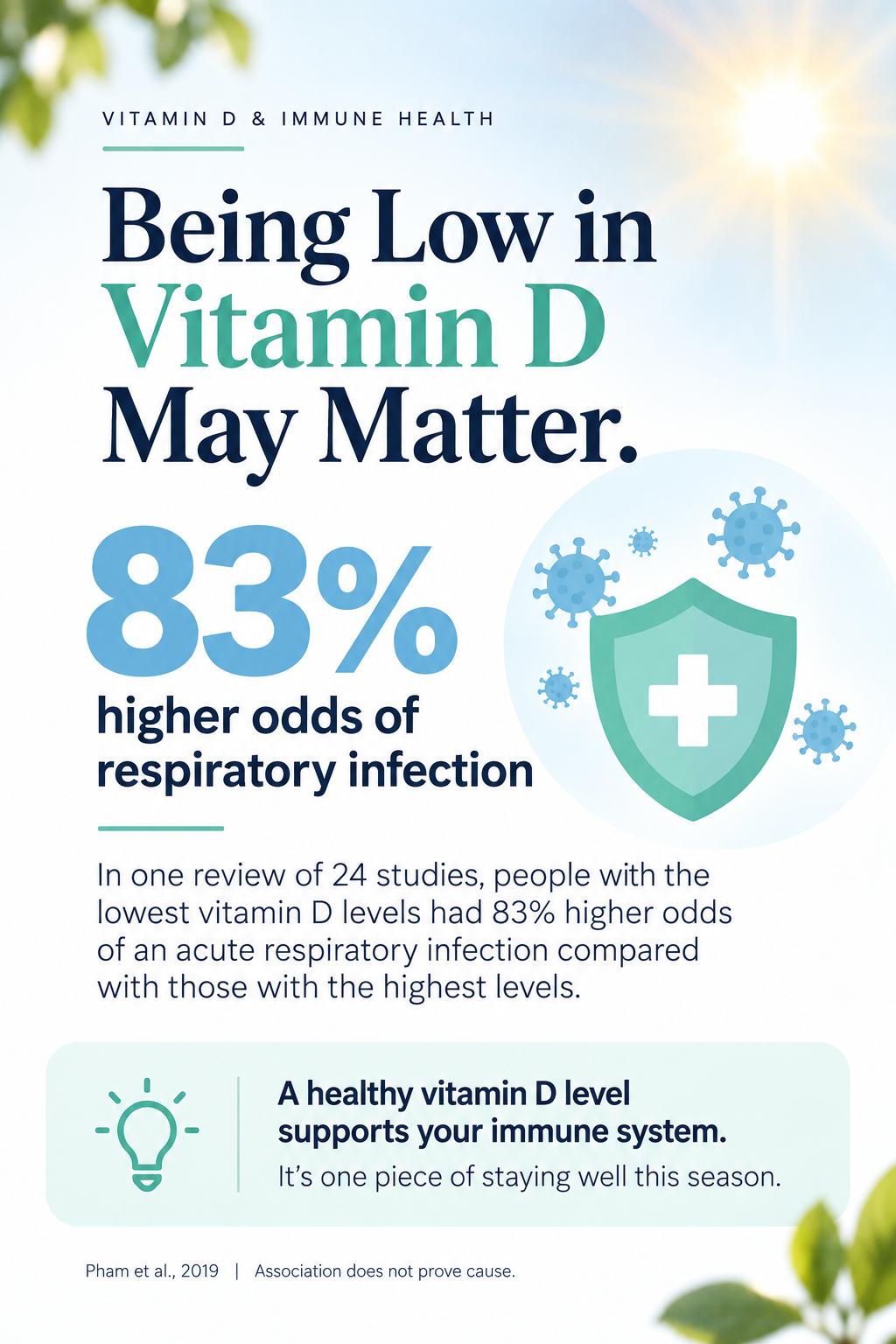
In the same review, people with the lowest vitamin D levels were also more likely to have a more serious respiratory infection.
Another review found that people who were low in vitamin D may also stay sick longer.
In the studies reviewed, respiratory illnesses lasted about 4 to 13 days in people who were vitamin D deficient, compared with about 2 to 8 days in people who were not deficient.
There is another interesting piece.
Researchers combined information from almost 11,000 people who had taken part in vitamin D trials.
Vitamin D supplements helped lower the risk of acute respiratory infections overall.
But the biggest benefit was seen in people who started with very low vitamin D levels and took vitamin D regularly, in daily or weekly amounts rather than occasional large doses.
That is the part I want you to remember.
This isn’t about taking huge amounts of vitamin D because cold-and-flu season is coming.
It’s about not quietly heading into winter low in something your immune system uses.
Why September Matters So Much in Canada
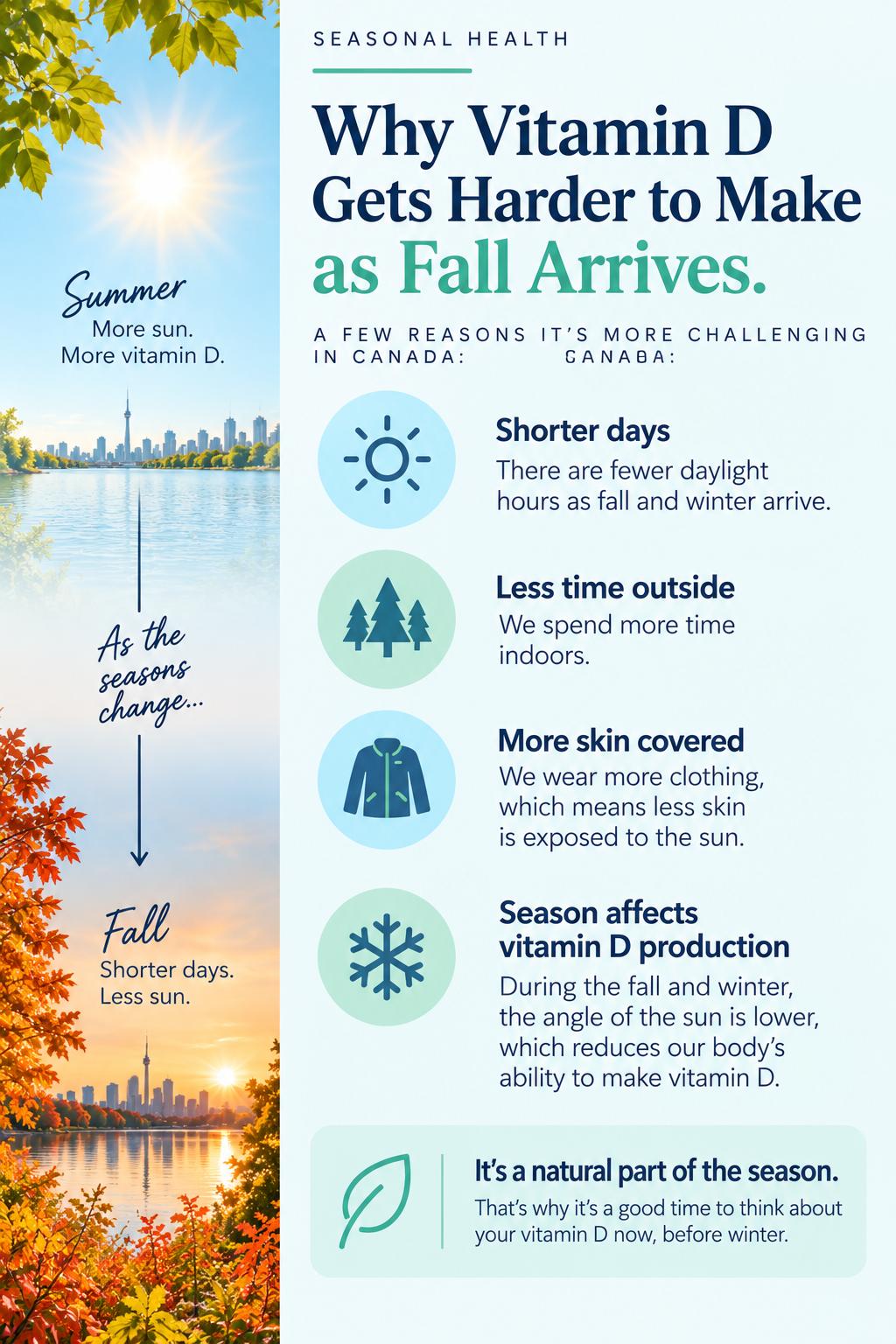
Your body can make vitamin D when your skin is exposed to sunlight.
That’s wonderful in July.
It gets a little trickier in November.
Health Canada notes that the amount of vitamin D we make from sunlight can be affected by the season, the time of day, cloud cover and smog, sunscreen use, how much time we spend outdoors, how much skin is exposed, our age and our skin pigmentation.
Now think about what happens over the next few months.
We spend less time outside.
We cover more of our skin.
The days get shorter.
Kids go back to school.
Offices get busier.
And before long, many of us leave home when it’s dark, spend most of the day indoors and come home when it’s dark again.
That’s a big change from summer.
And you don’t necessarily “feel” your vitamin D starting to drop.
You can have low vitamin D without obvious symptoms.
That’s why waiting until you feel deficient isn’t much of a plan.
Who Should Pay Extra Attention?
Vitamin D is worth thinking about for all of us as the seasons change, but there are some people who may have more reason to pay attention.
That includes people who spend most of their day indoors, rarely eat foods with much vitamin D, have been low in vitamin D before, have darker skin, or are getting older.
Age matters because our skin becomes less efficient at making vitamin D as we get older.
There are also health conditions that can affect how well our bodies absorb nutrients.
And then there is the opposite problem.
I sometimes meet people who have been taking a very large dose of vitamin D for years because someone once told them it was good for them.
They’ve never stopped to ask whether they still need that amount.
That’s worth looking at too.
So Where Do We Get Vitamin D?
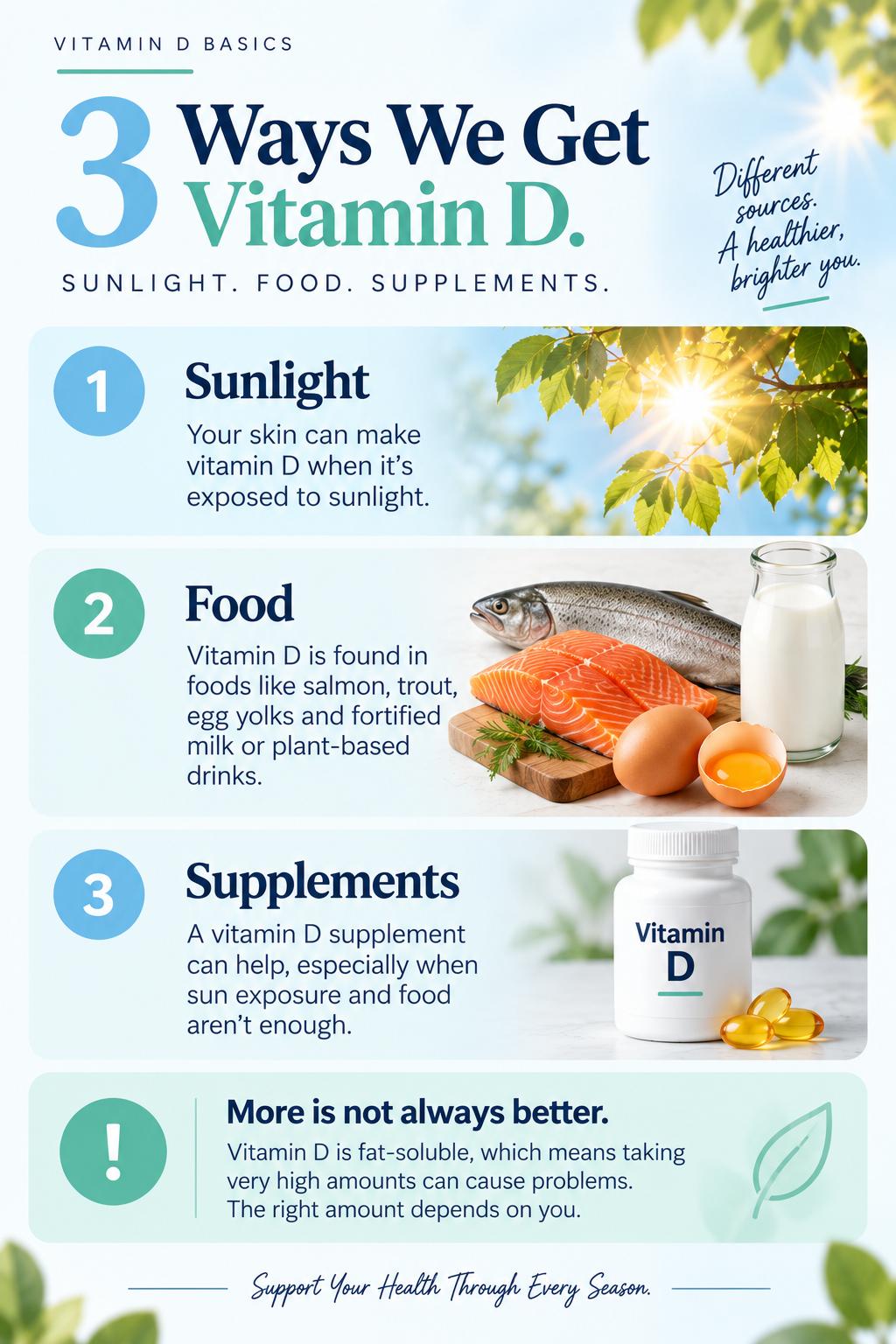
There are three main sources:
Sunlight, food and supplements.
Foods with vitamin D include fatty fish such as salmon, rainbow trout and Arctic char.
Egg yolks contain some vitamin D too.
In Canada, milk and some fortified plant-based beverages also contain vitamin D.
Health Canada recommends getting a source of vitamin D each day.
For adults aged 51 and older, Health Canada recommends a daily supplement containing 400 IU of vitamin D along with healthy eating.
For younger adults, vitamin D can come from vitamin-D-rich foods each day, or from a supplement when those foods aren’t being eaten regularly.
But here’s something important:
More is not always better.
Vitamin D is fat-soluble. That means taking very high amounts can cause problems.
Canada’s Dietary Reference Intakes set 4,000 IU per day as the tolerable upper intake level for most healthy adults, unless there is a medical reason to take more.
And I want to make this very clear:
4,000 IU is an upper limit. It isn’t a target.
If 1,000 IU is appropriate for somebody, taking 10,000 IU doesn’t automatically make them healthier.
Your vitamin D intake should make sense for you.
What About Testing?
Not everyone needs a vitamin D blood test.
For a healthy person with no special reason to test, routine testing isn’t always necessary.
But sometimes knowing your level can be useful.
Maybe you’ve been deficient before.
Maybe you’re taking a high dose.
Maybe there is a concern about how well you absorb nutrients.
Or maybe something else in your health history gives us a reason to look.
That’s a conversation worth having with your healthcare provider.
The goal isn’t to order every possible blood test.
The goal is to understand what your body may actually need.
Don’t Wait Until November
Every year, cold-and-flu season arrives.
And every year, many people wait until everyone around them is sick before they suddenly start thinking about their immune health.
I’d rather you get ahead of it.
September is a natural reminder.
You’re changing the kids’ schedules.
You’re putting away some of the summer clothes.
You’re getting back into your fall routine.
Add your vitamin D to that mental checklist.
- Are you getting vitamin D from your food?
- Are you taking a supplement?
- Do you know why you’re taking the amount you’re taking?
- Have you previously been low?
- Is there a reason you should discuss your vitamin D with your healthcare provider?
You don’t need to panic about winter.
And you don’t need a cupboard filled with supplements.
You just need to pay attention.
Because one of the biggest lessons I see in health is that it’s usually easier to take care of something before it becomes a problem.
So enjoy these last warm days.
Get outside while you can.
Eat the salmon.
And before summer completely disappears, give your vitamin D a little thought too.
Your November self may be very glad you did.
Not Sure What You Should Be Doing?
If you aren’t sure whether you’re getting enough vitamin D, whether your supplement dose makes sense, or whether there is a reason to look more closely at your levels, we can help.
At Higher Health, we look at the bigger picture — your health history, nutrition, supplements, symptoms and what you’re trying to improve — and help you decide what actually makes sense for you.
Sometimes that’s a simple change.
Sometimes bloodwork is useful.
And sometimes there are other parts of your health we need to look at too.
You don’t have to figure it all out from Google.
Book a complimentary 15-minute call with our team and let’s figure out a good starting point.
Dr. Tara Campbell, ND
Higher Health Naturopathic Centre
References & Further Reading
- Health Canada. Vitamin D. Information on vitamin D, sunlight, food sources and supplementation. Health Canada — Vitamin D
- Pham H, Rahman A, Majidi A, Waterhouse M, Neale RE. Acute Respiratory Tract Infection and 25-Hydroxyvitamin D Concentration: A Systematic Review and Meta-Analysis. International Journal of Environmental Research and Public Health. 2019;16(17):3020. View the study on PubMed
- Martineau AR, Jolliffe DA, Hooper RL, et al. Vitamin D supplementation to prevent acute respiratory tract infections: systematic review and meta-analysis of individual participant data. BMJ. 2017;356:i6583. Read the BMJ study
- Wang MX, Koh J, Pang J. Association between micronutrient deficiency and acute respiratory infections in healthy adults: a systematic review of observational studies. Nutrition Journal. 2019;18:80. View the study on PubMed
- Demay MB, Pittas AG, Bikle DD, et al. Vitamin D for the Prevention of Disease: An Endocrine Society Clinical Practice Guideline. Journal of Clinical Endocrinology & Metabolism. 2024. Endocrine Society Vitamin D Guideline
Medical Disclaimer
The information in this article is provided for general educational purposes only. It is general health information, not individual medical advice, diagnosis or treatment, and reading it does not create a practitioner-patient relationship with Higher Health Naturopathic Centre or any of its practitioners.
Vitamin D needs differ from person to person. A dose that is appropriate for one person may not be appropriate for another, particularly for people who take medications, are pregnant or breastfeeding, or live with a health condition. Speak with your naturopathic doctor, physician or another qualified health professional before starting, stopping or changing any supplement, and before deciding whether testing is right for you.
Never disregard professional medical advice, or delay seeking it, because of something you have read here. If you think you may be experiencing a medical emergency, call 911 or go to your nearest emergency department.
Last Updated on Saturday, September 5, 2026
Does IV Therapy Work? Here’s When It May Make Sense
Perimenopause and IV Therapy: What the Research Really Shows
How Much Iron Does a Woman Need Per Day? What 18 mg Actually Looks Like in Food
