
Does acupuncture work?
It’s a fair question.
After all, the basic idea involves putting very tiny needles into people and then telling them it may help them feel better. On paper, that sounds like something that deserves a little explaining.
Acupuncture has been used for thousands of years. But “people have been doing it forever” is not the same thing as scientific proof. We used to do plenty of things for thousands of years that probably don’t need a comeback.
What makes acupuncture interesting today — and why we use it at Higher Health — is that researchers have now studied it in thousands of people.
Studies have looked at acupuncture for back pain, arthritis, migraines, fertility, anxiety and many other health concerns.
And the results are not all the same.
For some conditions, the research is quite strong. For others, it looks promising but we still need better studies. And for a few things, acupuncture probably gets a little more credit on social media than it has earned in a research lab.
That is exactly why we like looking at the evidence.
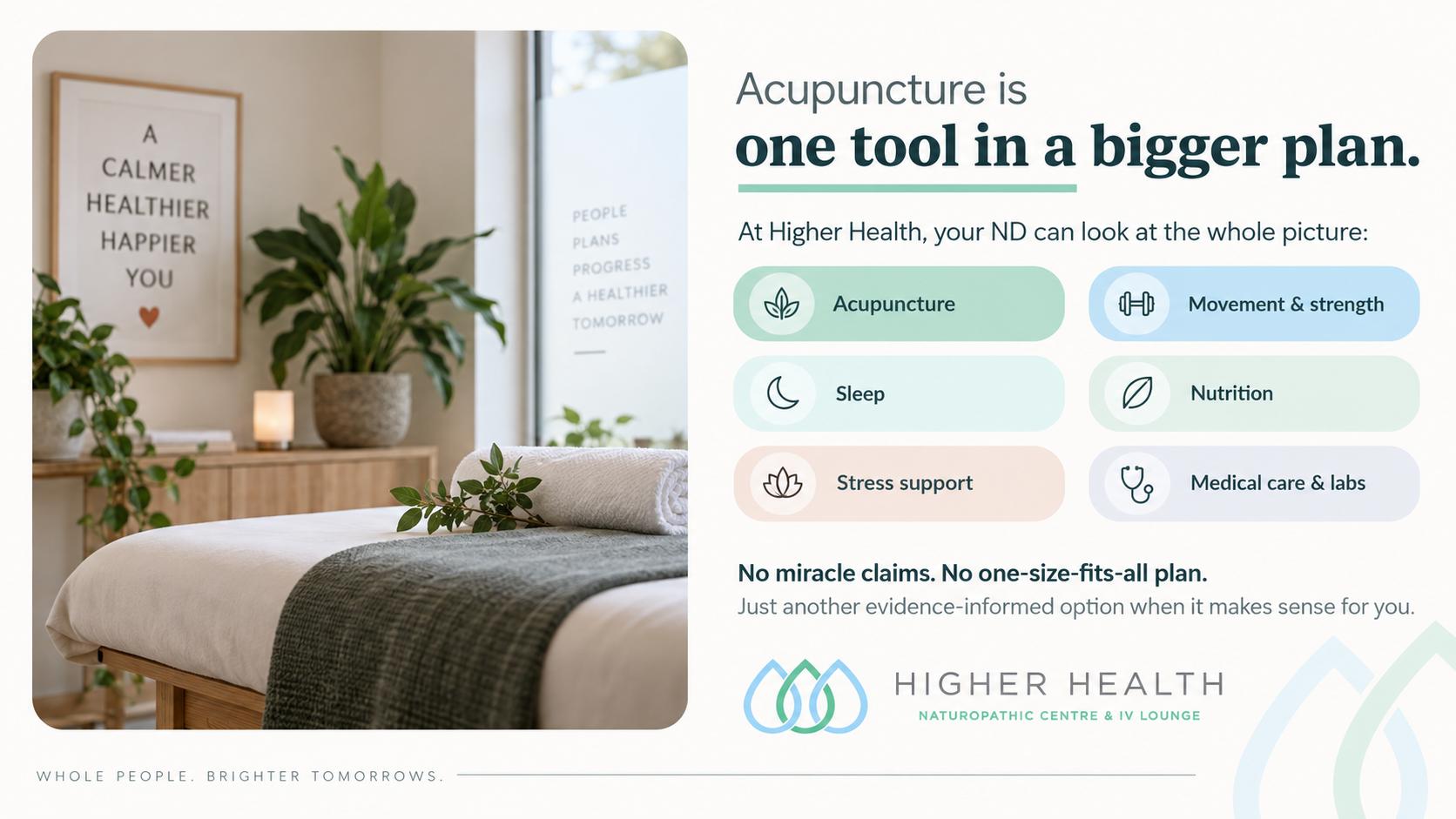
At Higher Health, our naturopathic doctors are trained in acupuncture. When it makes sense, it gives them another tool they can add to a larger treatment plan.
So instead of asking whether acupuncture “works” for everything, let’s ask a better question:
What does the research say it may actually help with?
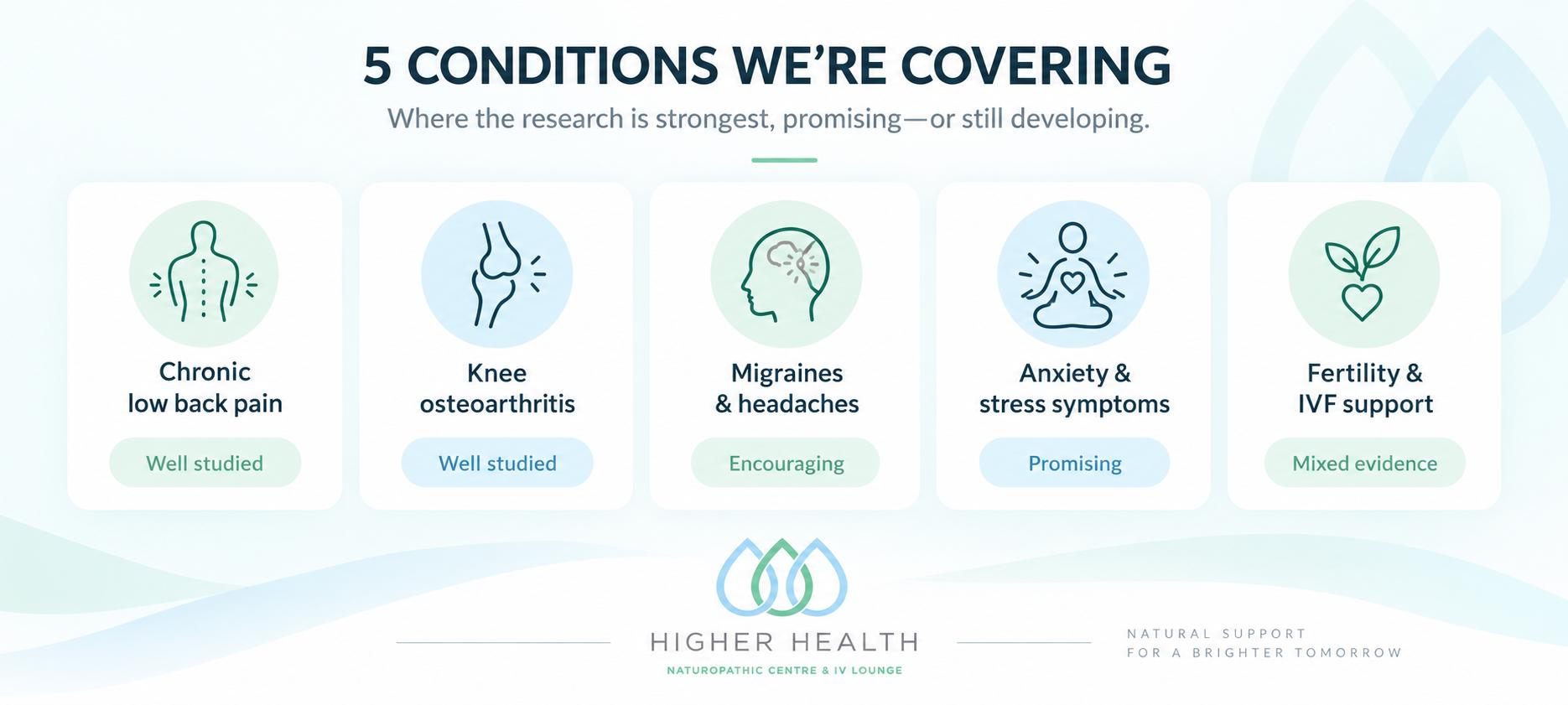
Here are five areas worth knowing about.
1. Chronic Low Back Pain
Low back pain has an annoying habit of becoming part of everyday life.
You bend differently. You avoid certain chairs. You learn exactly how slowly you need to get out of the car.
For some people, back pain lasts a few days.
For others, it can come and go for months or even years.
This is also one of the areas where acupuncture has been studied the most.
A 2026 review looked at eight clinical studies involving more than 1,100 people with chronic low back pain.
Overall, people who received acupuncture had less pain and better physical function than people receiving usual care.
The researchers did point out that some of the studies had limits. So this does not mean acupuncture works for every person with back pain.
But there is enough evidence to take it seriously as one possible part of treatment.
The U.S. National Center for Complementary and Integrative Health also notes that research suggests acupuncture may help some people with chronic low back pain.
What does that mean in real life?
We would not normally think of acupuncture as a replacement for movement, strength work, mobility or proper medical care.
It is another tool.
If acupuncture helps reduce pain enough for someone to move more comfortably, sleep better or get back to exercise, that may be valuable.
2. Knee Osteoarthritis
Knees have a remarkable ability to remind us that we are no longer 25.
Knee osteoarthritis becomes more common as we get older. It can cause pain, stiffness and swelling, and it can make simple things like walking, climbing stairs or exercising harder.
Acupuncture has been studied quite a bit for this.
A 2024 review looked at ten clinical studies involving more than 3,200 people with knee osteoarthritis.
The researchers found that acupuncture may help reduce knee pain and improve physical function.
In some studies, the improvements continued for several months after treatment ended.
That is important because the goal is not just to make a knee feel better for an afternoon.
The bigger goal is to help people keep moving.
Maintaining muscle, strength and activity becomes even more important as we age.
Acupuncture does not replace exercise, strength training, weight management when needed or medical treatment.
But if it helps someone move with less discomfort, it may be a useful part of the plan.
3. Migraines and Headaches
Anyone who gets migraines knows that “it’s just a headache” is a phrase that should probably be retired.
A migraine can mean hours or even days of pain, nausea, light sensitivity, sound sensitivity and feeling unable to do much of anything.
Researchers have looked at whether acupuncture can help.
A 2025 review included 23 clinical studies with almost 2,300 people who experienced migraines.
Compared with fake or “sham” acupuncture, people receiving real acupuncture had:
- fewer migraine days
- fewer migraine attacks
- shorter migraines
- improvements in some measures of quality of life
Not every migraine study has shown the same result.
So we would never tell someone that acupuncture will cure migraines.
A better question is:
Could it reduce how often migraines happen or how much they interfere with your life?
For some people, research suggests the answer may be yes.
At Higher Health, we would also look at other factors that may be involved.
That could include sleep, stress, hydration, muscle tension, hormones, nutrition, medication use and personal migraine triggers.
Acupuncture can then become one part of the larger picture.
4. Anxiety and Stress-Related Symptoms
Most people think of acupuncture for pain.
Fewer people think of it for that feeling of being permanently “on.”
Stress can show up in many ways: tight shoulders, poor sleep, headaches, a racing mind or feeling like your nervous system forgot where the off switch is.
Researchers are now studying acupuncture in this area too.
A 2026 review looked at 20 clinical studies involving more than 1,400 people with anxiety symptoms.
Overall, people receiving acupuncture had greater short-term improvements in anxiety scores compared with people receiving fake acupuncture or usual care.
The longer-term results were less clear.
There were also large differences between some of the studies.
So this is an area where the research is interesting, but it is not as strong as the research for pain.
Acupuncture should also never be seen as a replacement for proper mental-health care when someone has an anxiety disorder.
Where it may be useful is as one part of a larger treatment plan.
For someone dealing with stress, poor sleep, headaches and muscle tension, acupuncture may be another option worth considering.
5. Fertility and IVF Support
Fertility is one of the areas where acupuncture gets a lot of attention.
It is also one of those areas where the internet can occasionally run a little faster than the science.
Some people use acupuncture while trying to conceive naturally.
Others use it while going through fertility treatments such as IVF.
A large 2025 review looked at 42 studies involving about 7,400 women undergoing IVF.
The researchers found higher early pregnancy and clinical pregnancy rates in women who received acupuncture compared with women receiving fake acupuncture or no acupuncture.
Acupuncture was also linked with lower anxiety and less discomfort around fertility treatment.
That sounds encouraging.
But there is an important point.
Becoming pregnant is not the same as having a live birth.
So we would never tell someone that acupuncture will make IVF work or guarantee a pregnancy.
That would go beyond what the research shows.
Instead, acupuncture can be considered as one part of fertility care.
For some patients, that may include helping with stress, comfort and the overall experience of going through fertility treatment.
At Higher Health, we can also look at the wider picture.
That may include nutrition, sleep, stress, lifestyle, lab work and the care you are receiving from your fertility clinic.
Acupuncture is one tool within that larger plan.
So… Does Acupuncture Really Work?
The most accurate answer is:
For some health problems and some people, research suggests it can help.
That may not be as exciting as saying acupuncture works for everything.
But it is a much more useful answer.
The evidence is strongest in areas such as chronic pain, knee osteoarthritis and headaches.
Research into anxiety and fertility is also interesting, but the results are more mixed.
Scientists are also still studying exactly how acupuncture works.
Some research suggests acupuncture may affect how the nervous system processes pain. It may also influence the body’s own pain-control systems.
There is another interesting pattern that shows up in acupuncture research.
People receiving acupuncture sometimes do much better than people receiving no treatment, while the difference between real acupuncture and fake acupuncture can be smaller.
Researchers are still trying to understand exactly why.
From our point of view, the practical question is simpler:
Is acupuncture safe, appropriate for this person and likely to add something useful to their overall treatment plan?
If the answer is yes, it can be another option to consider.
One Thing Many Patients Don’t Know
You may not need to find a completely separate healthcare provider if you want to explore acupuncture.
In Ontario, naturopathic doctors can perform acupuncture as part of naturopathic care when they have the proper training and skills.
Our naturopathic doctors at Higher Health are trained in acupuncture.
That can make acupuncture easier to include in your care.
Your ND already knows your health history, what you are working on and what other treatments you may be using.
For example, if you are seeing us for migraines, we may already be looking at your sleep, stress, hormones, hydration, nutrition and muscle tension.
If acupuncture makes sense, it can be added to that plan.
It does not have to become a completely separate healthcare journey.
What About Your Health Benefits?
If your extended health plan includes naturopathic medicine, your visits with a naturopathic doctor may be covered according to the rules of your plan.
There is an important difference to understand.
Acupuncture performed by a naturopathic doctor as part of naturopathic care is not always treated by insurance companies the same way as acupuncture performed by a separately registered acupuncturist.
Coverage varies between plans.
If you are unsure, it is always best to check your individual benefits.
Higher Health also offers direct billing with many insurance companies where available.
Frequently Asked Questions About Acupuncture
And now for the questions people usually ask right before deciding whether they are willing to have someone put tiny needles in them.
What conditions can acupuncture help with?
Acupuncture has been studied for many health concerns.
Some of the better-supported uses include chronic low back pain, knee osteoarthritis, neck pain, headaches and migraines.
Researchers are also studying acupuncture for anxiety, fertility, sleep problems and many other concerns.
The evidence is stronger for some conditions than others.
Does acupuncture hurt?
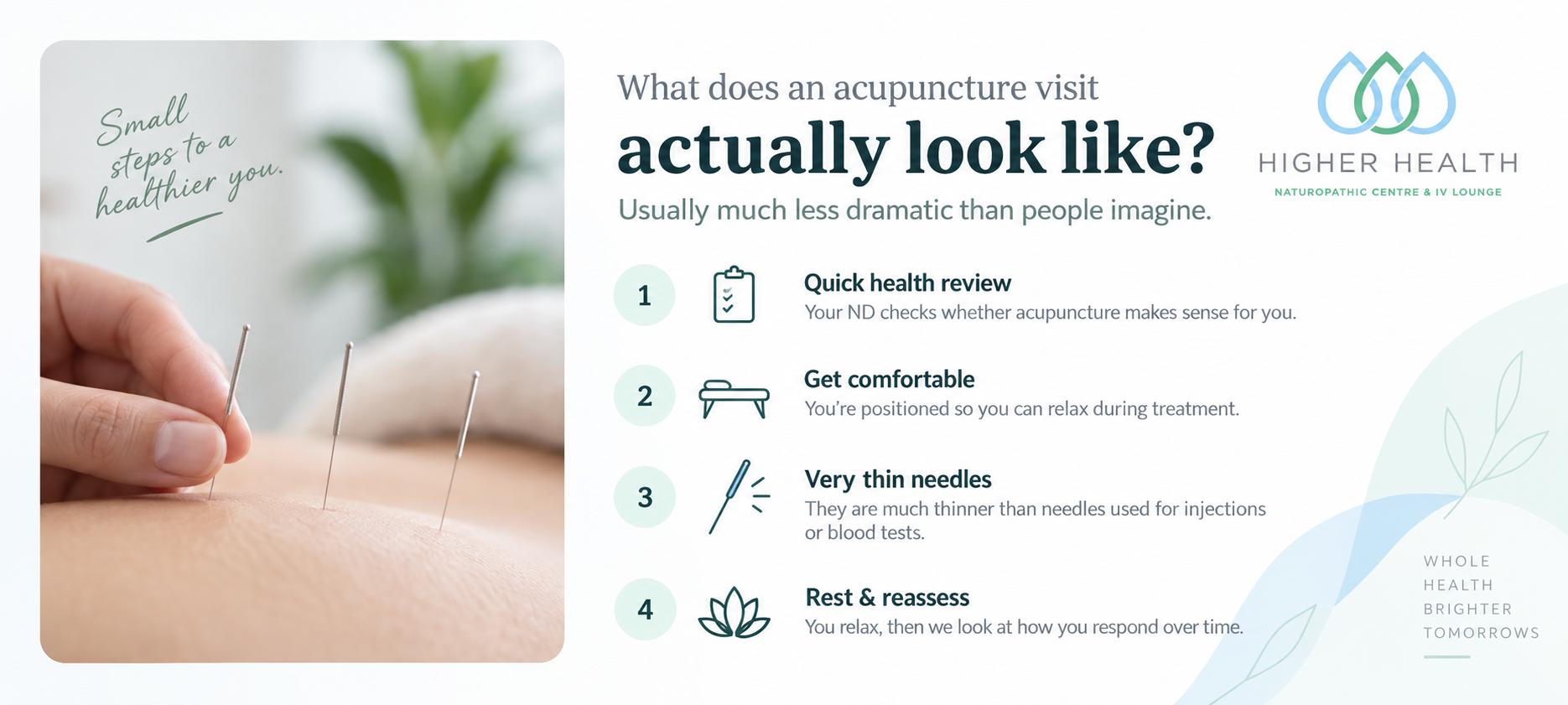
Usually much less than people expect.
Acupuncture needles are very thin. They are much smaller than the hollow needles used for injections or blood tests.
Some people barely feel them.
Others may notice a quick pinch, tingling, warmth, heaviness or a dull feeling around the needle.
Treatment should generally be comfortable.
Is acupuncture safe?
Acupuncture is generally considered safe when it is performed by a properly trained healthcare professional using sterile, single-use needles.
Minor side effects may include a small bruise, temporary soreness or a tiny amount of bleeding.
Your practitioner should also review your health history before treatment.
How many acupuncture treatments will I need?
There is no magic number.
Someone with a recent problem may need a very different treatment plan from someone who has had chronic pain for five years.
It depends on what is being treated, how long it has been going on and how you respond.
We prefer to see whether treatment is actually helping rather than automatically committing someone to a set number of visits.
How quickly does acupuncture work?
Some people notice a change after one or two visits.
Others may need several treatments before they can tell whether it is helping.
Most acupuncture research looks at a series of treatments rather than one single session.
The important question is whether there is a meaningful improvement over time.
Can acupuncture help back pain?
Research suggests acupuncture may help some people with chronic low back pain.
It is usually best considered as one part of a larger plan that may also include movement, strength, mobility and other appropriate care.
Can acupuncture help migraines?
Research suggests acupuncture may help reduce migraine days or attacks for some people.
Migraines can have many causes and triggers, so acupuncture is usually only one part of the assessment and treatment plan.
Can acupuncture help fertility?
Possibly, but this needs some context.
Some research has found higher pregnancy rates in people using acupuncture during fertility treatment.
We see acupuncture as a possible support during fertility care, not a guarantee of pregnancy or successful IVF.
When should I start acupuncture if I’m doing IVF?
There is no one acupuncture schedule that research has proven is best for everyone.
Some studies have used acupuncture before fertility treatment, while others have used it around egg retrieval or embryo transfer.
The best approach depends on the person and their fertility treatment plan.
Can a naturopathic doctor perform acupuncture in Ontario?
Yes.
Ontario naturopathic doctors can perform acupuncture as part of naturopathic care when they have the proper training, knowledge and skills.
The naturopathic doctors at Higher Health are trained in acupuncture.
Is acupuncture covered by insurance?
It depends on your insurance plan and who provides the treatment.
Acupuncture performed by a naturopathic doctor may be billed as naturopathic care rather than through a separate acupuncture benefit.
Check your individual plan if you are unsure.
Could Acupuncture Be Worth Trying?
If you are already a Higher Health patient, the easiest next step is simple:
Ask your naturopathic doctor whether acupuncture makes sense for the health concern you are currently working on.
You may already have another treatment option available to you that you have not considered.
And if you are new to Higher Health, acupuncture is one of several tools our Toronto naturopathic doctors can consider when building a treatment plan around your health, history and goals.
References
- Sotiropoulos S, et al. Acupuncture vs usual care for chronic low back pain: a systematic review and meta-analysis of immediate and intermediate effects. SICOT-J. 2026.
- Chen H, et al. Durable Effects of Acupuncture for Knee Osteoarthritis: A Systematic Review and Meta-analysis. Current Pain and Headache Reports. 2024.
- Lu T, et al. Acupuncture improves migraine and quality of life in patients with migraine: a systematic review with meta-analysis. Systematic Reviews. 2025.
- Jang A, et al. Acupuncture for Anxiety: A Systematic Review and Meta-Analysis of Randomized Controlled Trials. Journal of Clinical Psychology. 2026.
- Fu QW, et al. Acupuncture for women undergoing in vitro fertilization: An updated systematic review and meta-analysis with trial sequential analysis. International Journal of Nursing Studies. 2025.
- National Center for Complementary and Integrative Health. Acupuncture: Effectiveness and Safety.
- College of Naturopaths of Ontario. Standard of Practice: Acupuncture.
Last Updated on Friday, September 18, 2026
The Menopause Secret: Why Top Workplaces are Turning to Experts for Answers
Why Am I Always Tired?
Embracing the Change of Seasons: Boosting Energy and Well-being this Fall
