
Maybe you’ve heard great things about IV therapy.
Maybe a friend told you she felt amazing afterward.
Or maybe you’ve looked at an IV bag and thought: Is this really any different from taking vitamins at home?
It’s a fair question. And it’s the right one to ask: does IV therapy work, or is it just an expensive way to take vitamins?
And the answer is yes—but not for the reason you may think.
The biggest difference with IV therapy is simple: the nutrients don’t have to go through your digestive system first. They enter your bloodstream directly.
That can change how much of a nutrient your body is exposed to, how quickly it gets there and, with some nutrients, how high a level we can reach.
And in some situations, that can make a real difference.
Let’s look at why.
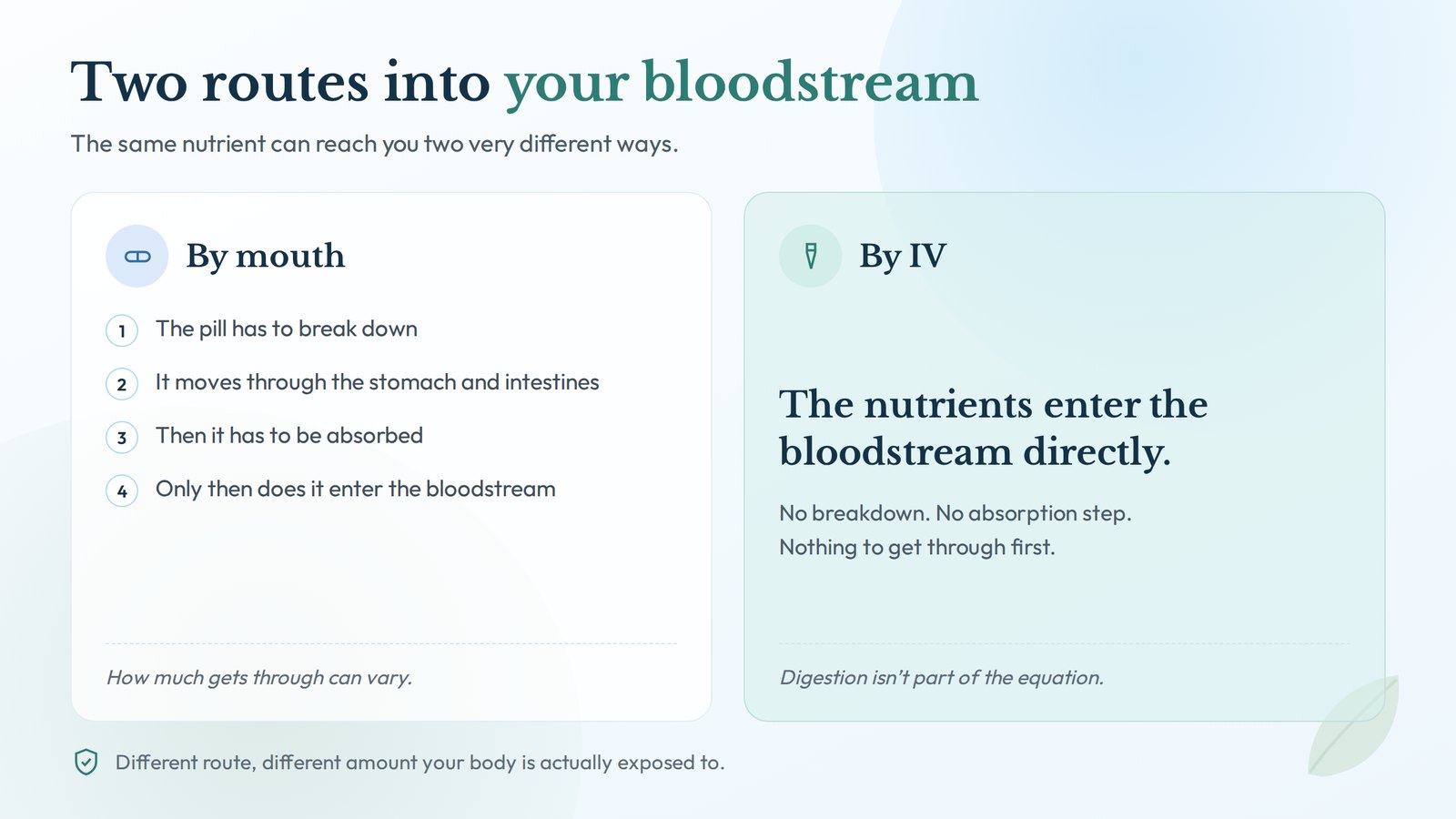
Taken by mouth, a nutrient has to survive digestion first. Through an IV, it doesn’t.
What Happens When You Swallow a Vitamin?
When you take a vitamin by mouth, your body has some work to do.
The pill has to break down. The nutrient has to move through your stomach and intestines. Then it has to be absorbed before it can enter your bloodstream.
For many people, this works perfectly well.
But it isn’t always that simple. Your digestion, medications, health conditions and even the size of the dose can affect how much of a nutrient gets through.
And here’s something many people don’t realize: taking a bigger dose doesn’t always mean your body absorbs a bigger dose.
Vitamin C gives us a great example.
At moderate amounts, the body absorbs vitamin C quite well. But as the oral dose gets larger, the percentage absorbed starts to fall. At doses above about 1 gram, less than half may be absorbed.
So swallowing more and more vitamin C doesn’t cause the amount in your blood to keep climbing at the same rate.
There is a limit.
An IV Takes a Different Route
An IV skips the stomach and intestines completely. The nutrients enter your bloodstream through the vein.
That means we don’t have to depend on your digestive system to absorb the dose first. Intravenous fluids and medications enter the bloodstream right away.
And sometimes that difference is significant.
Consider vitamin C again.
Researchers have found that oral vitamin C and IV vitamin C can create very different levels in the blood. The National Institutes of Health notes that IV vitamin C can produce concentrations far higher than oral vitamin C can achieve.
This is one of the most important things to understand about IV therapy: taking a large dose by mouth is not always the same thing as receiving a large dose through an IV.
The route matters.
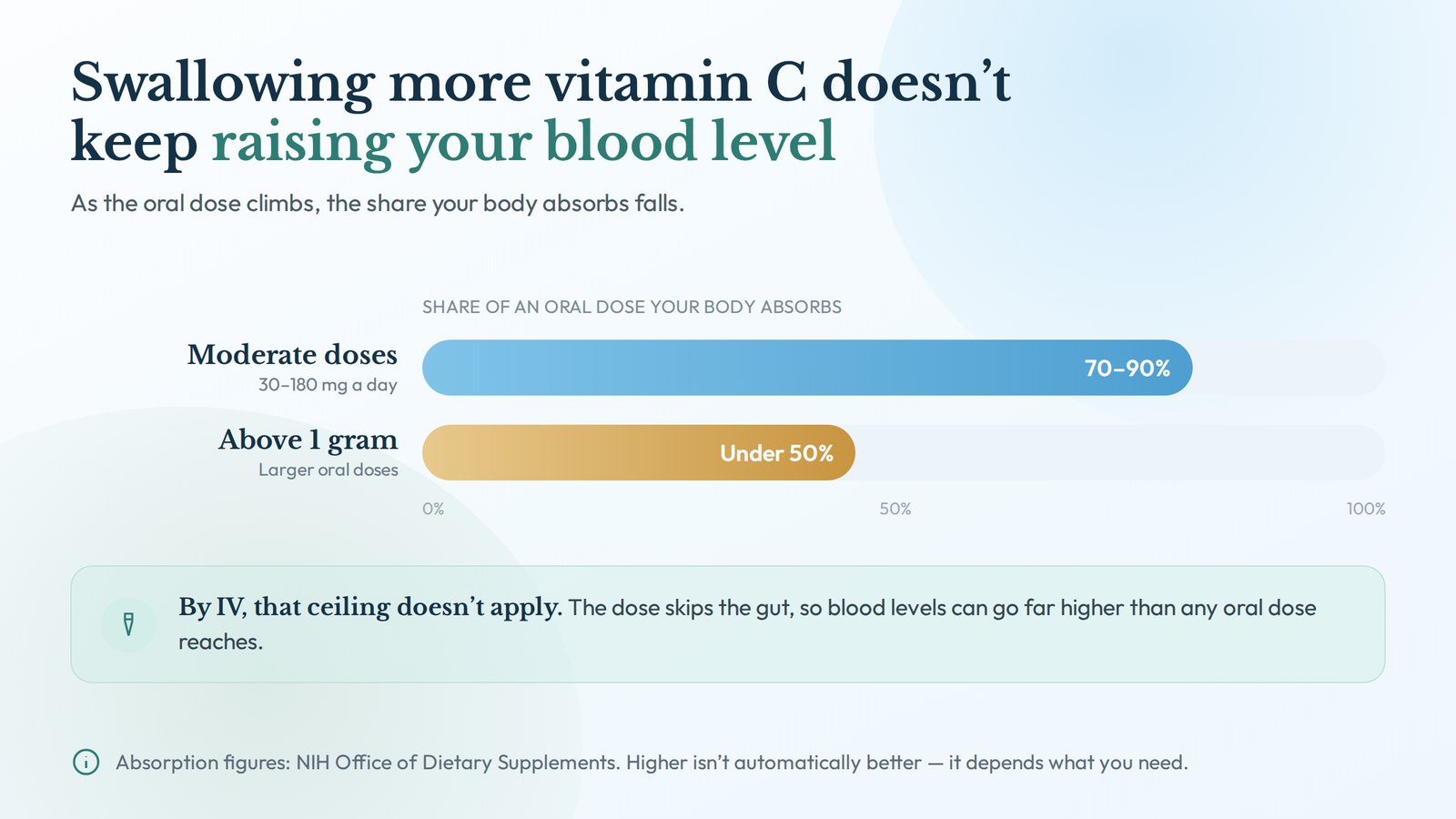
Absorption figures from the NIH Office of Dietary Supplements.
Why Would a Higher Level Matter?
This is where we have to be careful.
Higher is not automatically better.
If your body doesn’t need more of a nutrient, simply giving more doesn’t mean you will feel better.
But there are times when getting more of a nutrient into the body—or getting it there without relying on digestion—can be useful. And we have research showing that this can sometimes change outcomes.
A Good Example: Iron
Iron is something we see often in people who are tired, run down or struggling with low ferritin.
Oral iron can work very well.
But anyone who has taken iron pills also knows they can sometimes be hard on the digestive system. Constipation, nausea and stomach upset can make it difficult for some people to stay on them.
And for some people, even after taking oral iron for months, their iron stores remain low.
That’s where changing the route can matter.
IV iron bypasses the digestive system and puts the iron directly into circulation.
Research has found that IV iron can reduce fatigue in some iron-deficient women even when they are not yet anemic. One randomized trial found the benefit was strongest in women with very low ferritin.
A larger review of randomized trials also found that IV iron reduced fatigue and improved physical function in people with iron deficiency without anemia, although the authors noted that the overall quality of the evidence was limited.
That distinction matters.
It’s not: “IV iron is better for everyone.”
It’s: “For the right person, when low iron is actually the problem, changing how we deliver the iron can change the result.”
That’s an important difference.
Vitamin C Gives Us Another Example
Vitamin C is interesting because the digestive system puts a clear limit on how much we can absorb at one time.
IV vitamin C gets around that limit.
And researchers have tested whether that difference can affect how people feel.
In one randomized, double-blind study, 141 healthy adults received either saline or 10 grams of IV vitamin C. The people who received vitamin C reported less fatigue two hours after the treatment, and that difference was still seen the following day. The people who started with lower vitamin C levels appeared to benefit the most.
One study doesn’t mean IV vitamin C is the answer to every case of low energy.
But it does tell us something important: when we change the route and reach levels we can’t easily reach by mouth, the result may also change.
That’s why saying, “Why not just take a vitamin C pill?” doesn’t tell the whole story.
They aren’t always the same thing.
If you’ve been tired for a while and nothing you’ve tried has moved it, that’s worth a conversation before it’s worth an IV. You can book a free 15-minute call with one of our practitioners, or take the 60-second assessment. There’s no obligation either way — and sometimes the most useful outcome is finding out that nutrients aren’t what’s holding you back.
What If You’ve Been Taking Supplements but Still Don’t Feel Better?
This is where IV therapy becomes more interesting.
Maybe you’ve been taking supplements for months. Your cupboard is full of bottles. You’re doing what you’ve been told to do.
And yet you still feel tired, run down or like something is missing.
That does not automatically mean you need an IV. But it does raise some good questions.
- Are you absorbing what you’re taking?
- Is the dose enough for what you’re trying to correct?
- Is your digestive system limiting what you can tolerate?
- Are you even taking the right nutrients in the first place?
And perhaps most importantly: do we know why you aren’t feeling well?
Those are the questions we want to answer before simply adding another supplement.
What If Supplements Upset Your Stomach?
This is another reason someone may want to look at another route.
Sometimes the dose needed to correct a problem is also the dose your stomach doesn’t like.
Iron is a common example.
Higher amounts of oral vitamin C can also cause diarrhea, nausea and stomach cramps. The National Institutes of Health notes that these effects are linked in part to vitamin C that remains unabsorbed in the gut.
If you can’t comfortably take enough of a nutrient by mouth, an IV may give us another option.
Again, that’s not because IVs are magically better. We’re simply removing the digestive system from the equation.
What About IV Therapy for Low Energy?
This is probably one of the biggest reasons people ask us about IV therapy.
They aren’t usually saying, “I’d like more magnesium in my bloodstream.”
They’re saying, “I’m tired of feeling tired.”
And that’s where we think IV therapy needs to be done differently.
Fatigue can come from many places. Low iron may be involved. B12 may be low. You may not be eating enough. Sleep can be poor. Stress can be high. Hormonal changes can be part of the picture. Your thyroid may need to be looked at.
Or you may simply be depleted after illness, travel, a stressful period or weeks of not taking very good care of yourself.
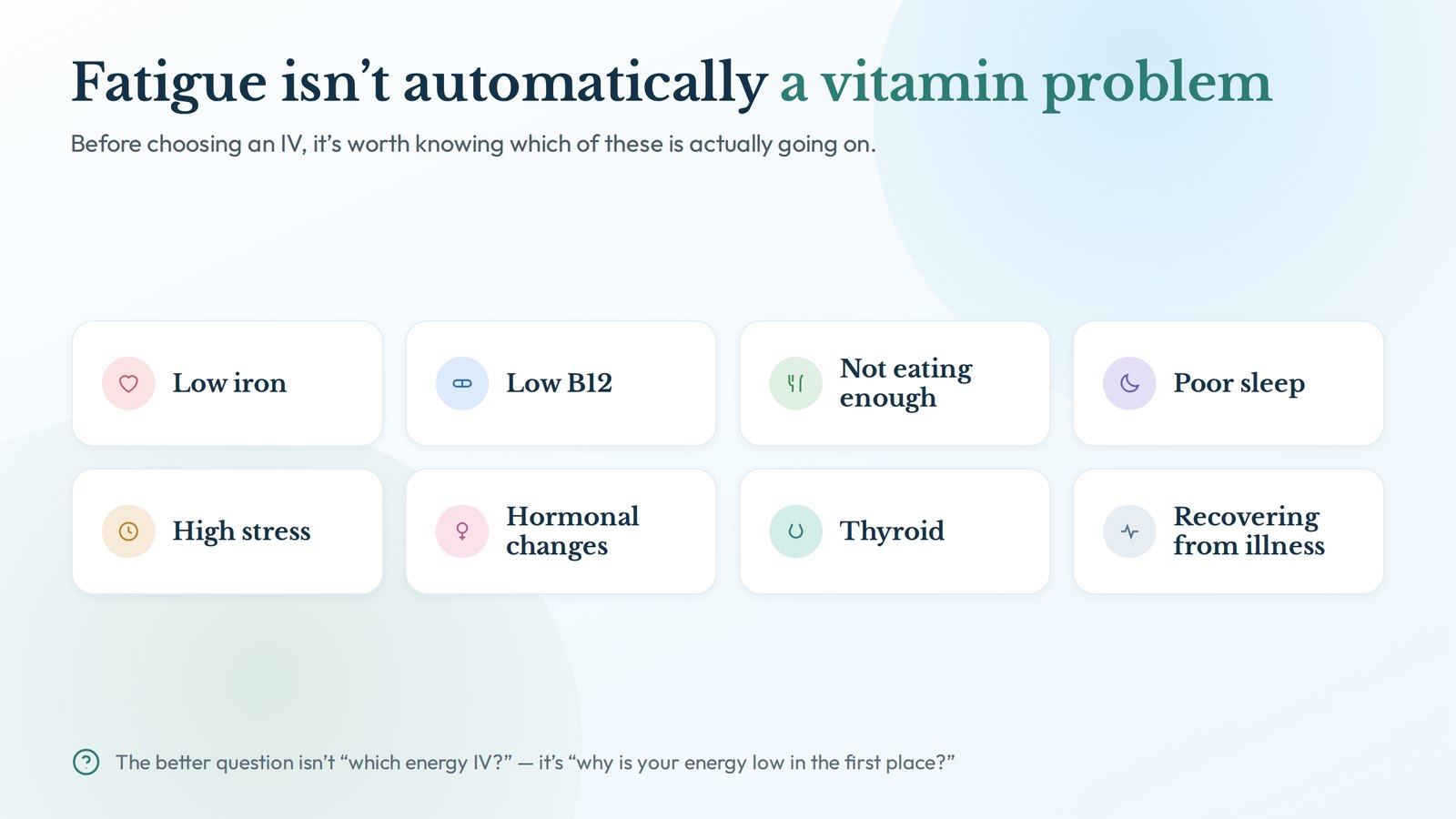
Fatigue has many possible causes. Which one it is changes what actually helps.
So rather than asking, “Which energy IV should I get?” we would rather ask, “Why is your energy low in the first place?”
Then we can decide whether IV therapy makes sense as part of the answer.
That’s very different from picking a colourful bag from a menu.
Does Everyone Need IV Therapy?
Definitely not.
And we don’t think telling everyone they need an IV builds much trust.
If you’re eating well, feeling great, absorbing nutrients normally and your bloodwork looks good, there may be no strong reason for you to receive high doses of nutrients through an IV.
Oral supplements can also work extremely well. For example, research has found that high-dose oral B12 can work as well as injections in many people with B12 deficiency.
That’s important because it shows the goal isn’t IV whenever possible.
The goal is to use the route that makes the most sense for you.
So When Does IV Therapy Become Worth Considering?
There are a few situations where we’d be more interested in having the conversation.
- Maybe you’ve been taking supplements but your levels aren’t moving the way you expected.
- Maybe a nutrient is difficult for you to tolerate by mouth.
- Maybe digestion or absorption is a concern.
- Maybe you’re trying to correct a known deficiency.
- Maybe you’ve been feeling run down and haven’t figured out why.
- Or maybe you simply want to understand whether getting nutrients directly into your bloodstream offers an advantage for what you’re trying to accomplish.
Those are all reasonable reasons to ask.
And asking doesn’t mean you have to get an IV.
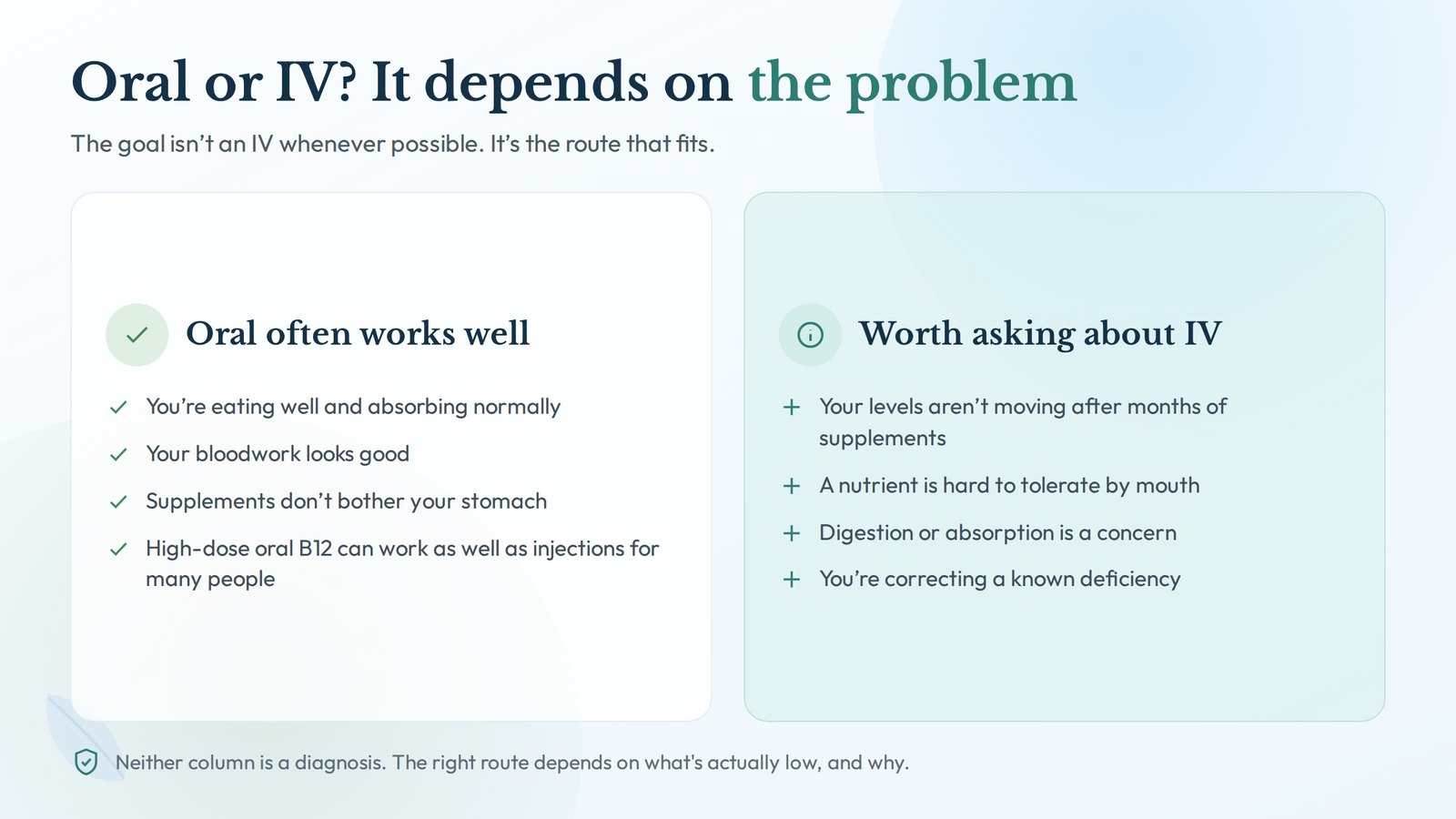
Neither column is a diagnosis — the right route depends on what is actually low.
How Fast Will You Feel an IV?
This varies.
The nutrients enter the bloodstream right away. But that doesn’t mean every person feels something the moment the IV starts.
Some people tell us they notice a difference quickly. Others notice changes later. And if we’re correcting something that has been low for months, it may take time before you feel the full benefit.
The research shows this too.
In the vitamin C fatigue study, a difference was seen within two hours. With iron deficiency, improvement is usually looked at over a much longer period.
How quickly you feel different depends on what we’re trying to change in the first place.
Is More Always Better?
No.
This may be one of the most important parts of this whole article.
The advantage of IV therapy is that we can bypass digestion and sometimes reach much higher levels. But that doesn’t mean everyone needs a high dose. And it certainly doesn’t mean every nutrient should be given at the highest possible amount.
There are nutrients and IV treatments that require extra screening. Health history matters. Medications matter. Kidney health can matter. Bloodwork can matter.
That’s why IV therapy should still be treated like healthcare—not like ordering a smoothie.
So, Does IV Therapy Work?
Yes.
IV therapy is an effective way to deliver fluids and nutrients directly into your bloodstream without relying on your digestive system first.
For certain nutrients, that can create blood levels that are difficult or impossible to reach through oral supplements. Vitamin C is a very clear example.
And there are situations where using the IV route has led to better results for appropriately selected people, including research involving IV iron and fatigue and IV vitamin C.
But here’s the part that matters most: the question isn’t whether an IV can put nutrients into your bloodstream. We know it can.
The real question isn’t does IV therapy work in general. It’s whether it would make a meaningful difference for you.
And that’s a much better conversation to have.
Could IV Therapy Make Sense for You?
Maybe you’ve tried supplements and still don’t feel the way you’d like. Maybe your energy isn’t what it used to be. Maybe you’ve had bloodwork showing that certain nutrient levels aren’t where they should be. Maybe your digestion makes supplements difficult.
Or maybe you’re simply curious about whether IV therapy could give you something oral supplements can’t.
You don’t need to figure out which IV you need before reaching out. In fact, we’d rather you didn’t.
At Higher Health, IV formulas are built with a licensed practitioner around your health history, goals and, when appropriate, bloodwork.
You can start with a free IV therapy consultation call with one of our IV Therapy certified Naturopathic Doctors. The purpose of the call is simply to talk about what’s going on, what you’re hoping to improve and whether IV therapy is worth exploring for you.
Sometimes it will be. Sometimes we’ll want to look at something else first.
Either way, you shouldn’t have to guess.
Ready to find out if IV therapy makes sense for you?
Come with your questions. You don’t need to know which IV to choose.
We’ll help you figure out whether IV therapy is a reasonable next step—and what that could look like for you.
Quick Questions About IV Therapy
Are IV vitamins better than pills?
Not always. Oral supplements can work very well. IV therapy becomes more useful when digestion, absorption, tolerance, speed or the amount we want to deliver matters.
Do IV vitamins bypass digestion?
Yes. An IV delivers the ingredients directly into your bloodstream rather than requiring them to first be absorbed through your stomach and intestines.
Can an IV give me more vitamin C than I could absorb from pills?
Yes. Oral vitamin C absorption falls as doses become larger, while IV vitamin C can produce much higher levels in the blood.
Can IV therapy help with fatigue?
It may help some people, depending on why they’re tired. Research has found improvements in fatigue in certain people receiving IV iron or IV vitamin C, but fatigue has many possible causes and should not automatically be treated as a vitamin problem.
Does IV therapy work for everyone?
No, and we don’t think it should be sold that way. It works when the route is the thing standing in your way — poor absorption, a dose you can’t tolerate by mouth, a deficiency that hasn’t moved. If none of those apply, oral supplements may do the same job.
How do I know which IV I need?
You don’t have to decide that yourself. You can also take our free IV therapy assessment. At Higher Health, a licensed practitioner reviews your health history and goals and helps determine whether IV therapy is appropriate and what formula may make sense.
Want to go deeper? Our IV therapy FAQ and research library covers more of the common questions.
This article is for educational purposes and is not a substitute for individual medical care. IV therapy is not appropriate for everyone. Your health history, medications, bloodwork and individual risk factors should be considered before treatment.
Selected Research
- National Institutes of Health, Office of Dietary Supplements. Vitamin C: Fact Sheet for Health Professionals. Reviews oral vitamin C absorption and the much higher blood concentrations possible with intravenous vitamin C.
- Suh SY, Bae WK, Ahn HY, et al. Intravenous vitamin C administration reduces fatigue in office workers: a double-blind randomized controlled trial. Nutrition Journal. 2012;11:7.
- Krayenbuehl PA, Battegay E, Breymann C, Furrer J, Schulthess G. Intravenous iron for the treatment of fatigue in nonanemic, premenopausal women with low serum ferritin concentration. Blood. 2011;118(12):3222–3227.
- Dugan C, Cabolis K, Miles LF, Richards T. Systematic review and meta-analysis of intravenous iron therapy for adults with non-anaemic iron deficiency: an abridged Cochrane review. Journal of Cachexia, Sarcopenia and Muscle. 2022;13(6):2637–2649.
- Vidal-Alaball J, Butler CC, Cannings-John R, et al. Oral vitamin B12 versus intramuscular vitamin B12 for vitamin B12 deficiency. Cochrane Database of Systematic Reviews. 2005;(3):CD004655.
Last Updated on Saturday, September 5, 2026
Why Am I Suddenly So Achy? Could It Be Perimenopause?
The Vitamin D Conversation I’d Rather Have Now Than in January
Perimenopause and IV Therapy: What the Research Really Shows
