
By Dr. Tara Campbell, ND
Maybe your sleep suddenly isn’t what it used to be. You wake at 3 a.m. for no obvious reason. Your energy is unpredictable. Your workouts feel harder to recover from.
You feel foggier, more easily overwhelmed, or as though the body you knew for decades has quietly changed the rules.
Sometimes your cycle has changed dramatically. Sometimes it hasn’t.
And often, the hardest part is simply this: “I don’t feel like myself anymore.”
Our team at Higher Health in Toronto hears some version of that from women every week.
Hormones are part of the story. They aren’t the whole story. Researchers following women through this stage of life have found real, measurable changes happening in the blood vessels. In one study, a single IV vitamin C infusion improved artery flexibility by about 15% in women in late perimenopause.
That finding is worth understanding, and worth understanding accurately. Here is what it shows, what it doesn’t, and where IV nutrient therapy may fit into a midlife health plan.
Estrogen does more than most women realize
Most of us learn to associate estrogen with reproduction: periods, pregnancy, fertility, hot flashes. But estrogen interacts with many other systems, including the blood vessels.
As estradiol declines through the menopause transition, researchers have observed changes in how well those blood vessels function. One factor they keep returning to is oxidative stress.
The basic idea is simple. Every day your body produces reactive molecules as a byproduct of normal metabolism. It also runs antioxidant systems that keep those molecules in check. Oxidative stress is what happens when that balance tips.
It isn’t a disease, and it doesn’t explain every symptom of perimenopause. But it appears to matter more as estrogen falls, especially later in the transition.
So researchers asked a question they could actually test: if oxidative stress is driving these changes, what happens when you give the body a powerful antioxidant?
The antioxidant they chose was vitamin C, given by IV, because that is the only route that reaches the blood levels the experiment required.
What happened when women received IV vitamin C
Researchers at the University of Colorado studied 97 healthy women at four different stages of the menopause transition. They measured the flexibility of the carotid artery before and during an IV vitamin C infusion.
The response was not the same in every woman. It depended almost entirely on where she was in the transition:
- Premenopause: no significant change
- Early perimenopause: no significant change
- Late perimenopause: artery flexibility improved by about 15%
- Postmenopause: improved by about 17%
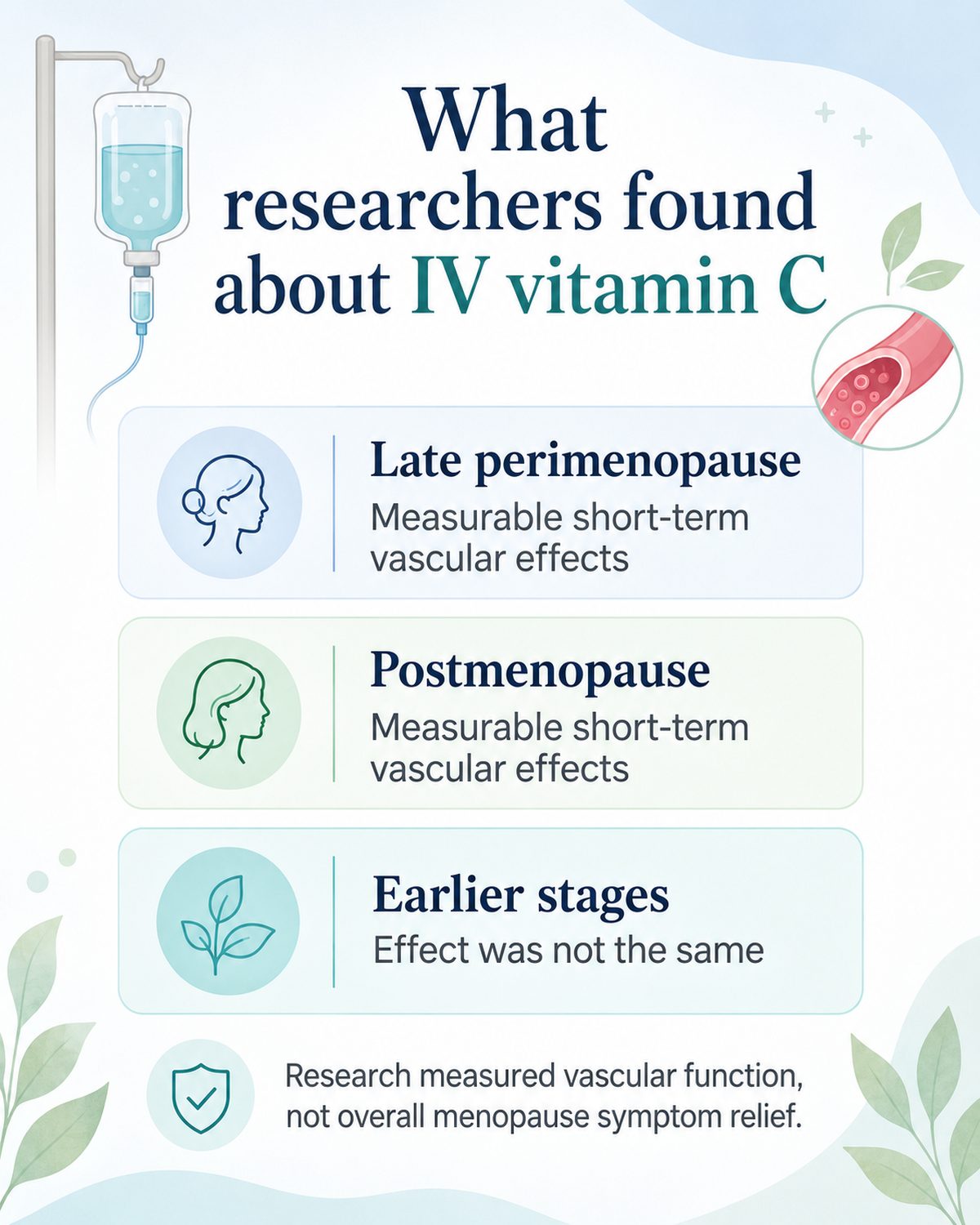
That pattern matters. Researchers weren’t simply checking whether vitamin C showed up in the bloodstream. They were measuring a real physiological response, and it appeared exactly where the oxidative stress theory predicted it would.
Later research found the same pattern. Other studies in postmenopausal women have reported similar improvements in blood-vessel function, and one found an improvement in how the heart relaxes and fills.
Something happened, and researchers could measure it.
The changes happening in your body during this transition are real, measurable, and at least partly responsive to intervention.
Being straight with you about the evidence
We want to be clear about how far this research goes, because that honesty is part of good care.
These studies measured changes in blood-vessel function during and shortly after an infusion. They were designed to test a mechanism, not to evaluate a treatment. Individual responses varied.
So the research does not show that IV vitamin C treats hot flashes, restores sleep, clears brain fog or prevents heart disease.
What it does show is that this transition produces real changes that can be measured, and that at least some of them respond to intervention. That is a meaningful finding. It is why we think targeted nutrient support deserves to be taken seriously rather than dismissed as a wellness trend.
What this means if you’re the one feeling it
Maybe you’re reading this because you’re exhausted, sleeping badly, or you just don’t feel like yourself. If so, we don’t want you walking away thinking “I need vitamin C.”
We want you thinking: maybe there’s more happening in my body right now than I realized.
That’s the bigger lesson. Perimenopause isn’t simply a period problem. It’s a biological transition that touches many systems at once, and this research is one well-documented example.
What we look at before we ever mention an IV
When a woman comes to Higher Health feeling depleted, the first question our naturopathic doctors and nurse practitioners ask isn’t “which IV should we give her?”
It’s: what has changed?
We want the whole picture:
- What’s happening with your cycle
- How you’re sleeping
- What your energy looks like across the day
- How you respond to exercise, and how you recover
- Whether you’re eating enough protein
- What your recent bloodwork shows, including iron, vitamin B12, thyroid and blood sugar
- Any medications or supplements you’re already taking
And most importantly: what do you want to feel better about?
Two women can both be 48 and need completely different plans. For one, the priority might be resistance training and more protein. For another, we may need to look into iron status. Another may benefit from discussing hormone therapy with an appropriate medical provider.
And for many women, individualized IV nutrient therapy is a valuable layer of support within that plan.
That’s where our team believes IV therapy belongs. Not as the whole plan, but as a tool that makes the plan stronger.
Can’t I just take a pill?
Good nutrition still matters. Oral supplements still have an important role.
What an IV offers is a different route. Nutrients go directly into the bloodstream, in a controlled and clinically supervised setting, at levels oral intake can’t always reach. That is the same reason researchers used an infusion rather than a tablet.
It also lets us be precise. Instead of assuming every woman needs the same pre-made “menopause drip,” we choose the ingredients around her health history, medications, symptoms and goals.
At Higher Health, we don’t want you picking an IV off a menu because the name sounds like your symptoms. We want to understand why you feel the way you do first. Then we build the IV around you.
Maybe we’ve been asking the wrong question
Women often ask: “Do IVs work for menopause?”
There’s a better question: given what’s changing in my body right now, could targeted nutrient support have a useful place in my plan?
That’s a far more productive conversation. We know this transition involves changes well beyond the symptoms we usually talk about. We know falling estrogen appears to interact with oxidative stress and blood-vessel function. And we have human research showing that IV vitamin C produces measurable effects in women later in the transition.
There is more to learn. But there is enough here to take the conversation seriously.
You don’t need to figure this out before you come in
You don’t need to arrive knowing which nutrients you need, or whether your symptoms are hormonal, or whether an IV is right for you. That’s what our team is for.
Bring your recent bloodwork if you have it. Tell us what has changed, what you’re struggling with, and what you’ve already tried.
Maybe IV nutrient therapy will have a place in your plan. Maybe something else needs attention first. Often the best plan is several pieces working together.
Because the goal isn’t simply to get through menopause. It’s to understand what your body needs now, and to support your health through this next stage of life.
Book a perimenopause appointment in Toronto
If your energy, sleep, recovery or overall sense of well-being has changed, let’s take a closer look.
Book with Dr. Tara Campbell, ND, or another member of our team of naturopathic doctors and nurse practitioners at Higher Health in Toronto.
Book Your Free Consultation Call
Prefer to start with a specific question? You can also book a free hormone health call or a free IV therapy info call.
IV nutrient therapy is individualized and is not appropriate for everyone. The research discussed in this article relates to acute intravenous vitamin C and vascular outcomes in research settings. It does not establish IV therapy as a treatment for menopause symptoms, as a means of preventing cardiovascular disease, or as a substitute for appropriate medical care.
Research referenced
- Hildreth KL, Kohrt WM, Moreau KL. Oxidative stress contributes to large elastic arterial stiffening across the stages of the menopausal transition. Menopause. 2014;21(6):624–632.
- Moreau KL, Hildreth KL, Klawitter J, Blatchford P, Kohrt WM. Decline in endothelial function across the menopause transition in healthy women is related to decreased estradiol and increased oxidative stress. GeroScience. 2020;42(6):1699–1714.
- McSorley PT, Young IS, Bell PM, Fee JPH, McCance DR. Vitamin C improves endothelial function in healthy estrogen-deficient postmenopausal women. Climacteric. 2003;6(3):238–247.
- Moreau KL, Gavin KM, Plum AE, Seals DR. Ascorbic acid selectively improves large elastic artery compliance in postmenopausal women. Hypertension. 2005;45(6):1107–1112.
- Ozemek C, Hildreth KL, Groves DW, Moreau KL. Acute ascorbic acid infusion increases left ventricular diastolic function in postmenopausal women. Maturitas. 2016;92:154–161.
Last Updated on Saturday, September 5, 2026
The Vitamin D Conversation I’d Rather Have Now Than in January
Does IV Therapy Work? Here’s When It May Make Sense
How Much Iron Does a Woman Need Per Day? What 18 mg Actually Looks Like in Food
