
By Dr. Tara Campbell, ND
Recently, I was reviewing a patient’s health history, bloodwork and diet because her symptoms made us take a closer look at her iron.
During our conversation, she asked me: “How much iron should a woman actually be getting every day?”
So, how much iron does a woman need per day? For most women between the ages of 19 and 50, the answer is 18 mg.
That was the easy part of the answer. The more useful question came next:
“What does 18 mg of iron actually look like in food?”
Knowing the number is helpful. But knowing how to reach it—and whether reaching it is enough for you—is what makes the information useful. So let’s make that number real.
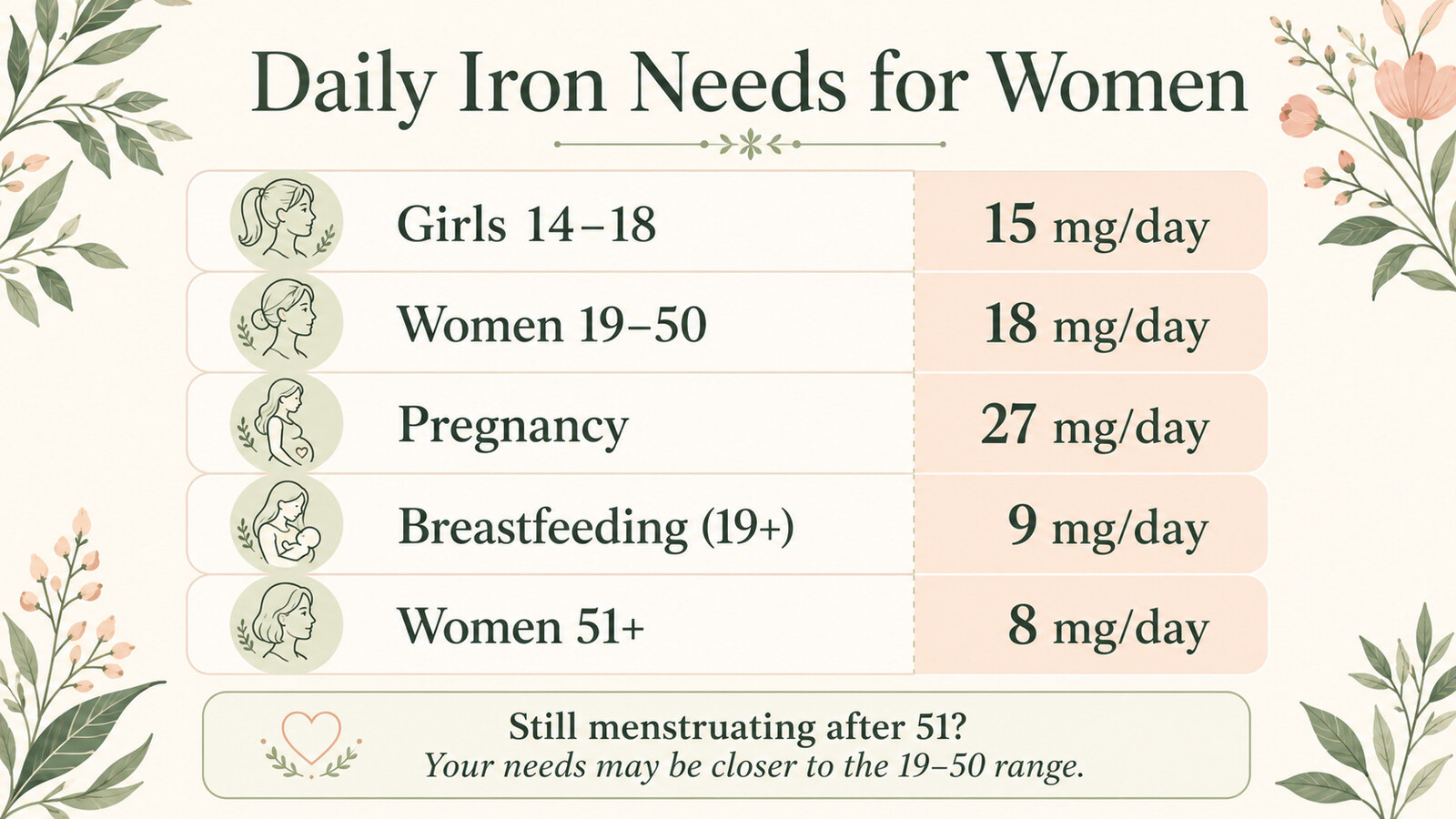
How Much Iron Does a Woman Need Per Day at Different Ages?
Iron needs change throughout a woman’s life.
| Age or life stage | Recommended iron per day |
|---|---|
| Girls aged 14–18 | 15 mg |
| Women aged 19–50 | 18 mg |
| Pregnancy | 27 mg |
| Breastfeeding, age 19+ | 9 mg |
| Women aged 51+ | 8 mg |
These are general daily intake targets for healthy people. They are not supplement doses or treatment recommendations for someone whose iron stores are already low.
Health Canada also notes that health, physiology and lifestyle can affect an individual’s requirements.
Still Menstruating After Age 51?
The drop from 18 mg to 8 mg assumes that menstrual bleeding has stopped. But menopause does not arrive on everyone’s 51st birthday.
If you are still menstruating—especially if your periods are heavy—the higher recommendation may still be the more useful reference point.
In other words: whether you still have a period may matter more than the age on your driver’s licence.
Click to Enlarge
Why the Daily Number Only Tells Us So Much
Two women can eat the same amount of iron and end up with very different iron stores.
One may have heavy periods. One may donate blood regularly. One may absorb iron well, while another has a digestive issue that makes absorption more difficult. One may already be starting with depleted iron stores.
The number is useful. It just cannot tell me everything I need to know about the woman sitting in front of me. Your iron status is also influenced by:
- How much iron you consistently eat
- How much of that iron your body absorbs
- How much iron your body currently needs
- How much iron you are losing
This matters because low iron is common. Health Canada reports that approximately 1 in 4 Canadian women between the ages of 14 and 50 has low iron status.
That does not mean one in four women needs a supplement or an iron infusion. It does mean iron deserves more attention than the usual advice to “eat more spinach.”
Heme Iron and Non-Heme Iron: What Is the Difference?
Iron comes in two main forms.
Heme iron is found in meat, poultry, fish and seafood. Your body generally absorbs it more easily.
Non-heme iron is found in eggs, lentils, beans, tofu, seeds, dark green vegetables and foods with added iron, such as certain breakfast cereals. These foods can provide a meaningful amount of iron, but the body does not absorb this form as easily.
That does not make plant-based iron a poor choice. It simply means how you build the meal matters.
One Simple Way to Absorb More Iron
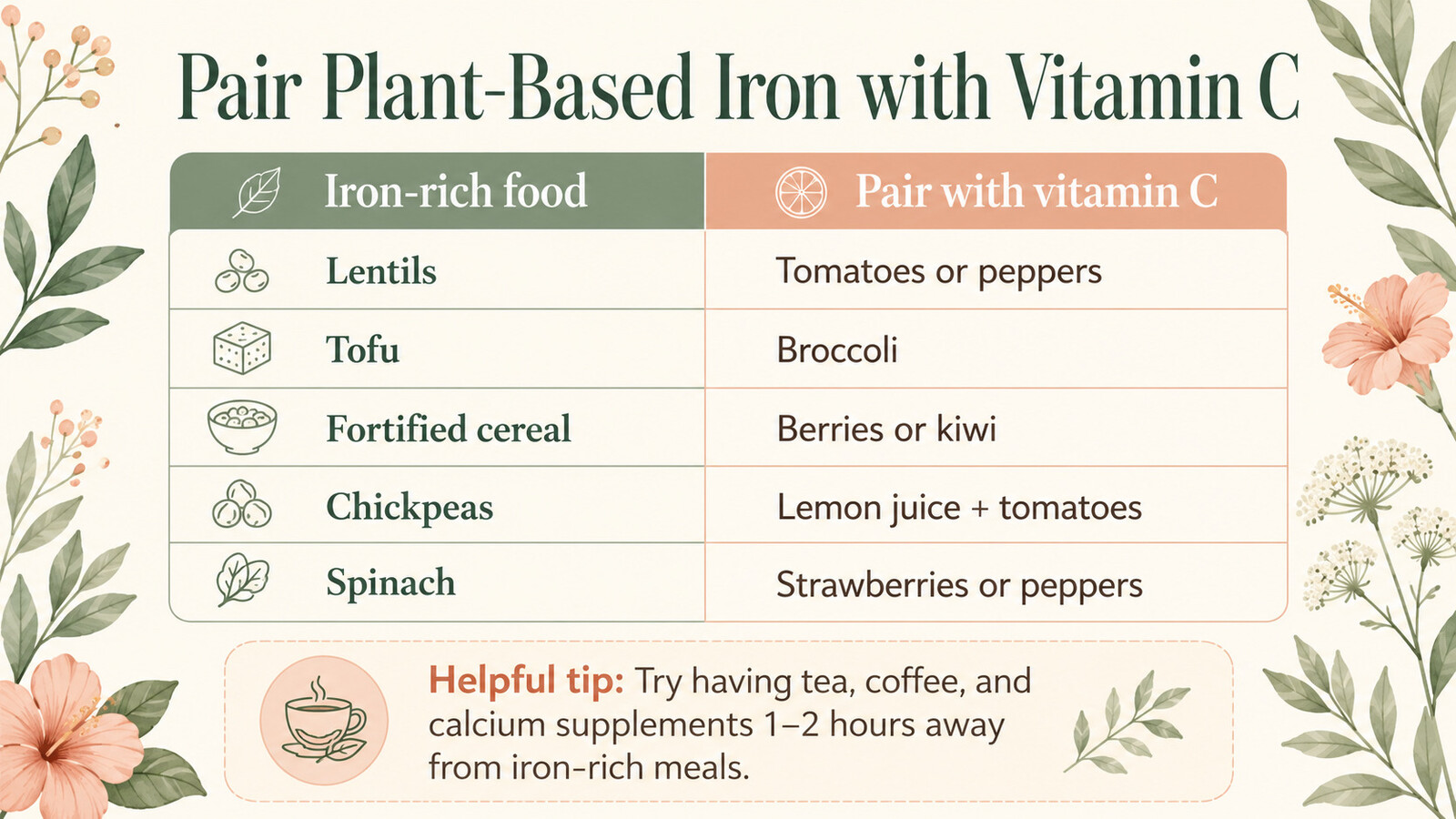
When a meal contains plant-based iron, add a source of vitamin C. For example:
- Lentils with tomatoes or peppers
- Tofu with broccoli
- Iron-fortified cereal with berries or kiwi
- Chickpeas with lemon juice and tomatoes
- Spinach with strawberries or peppers
Vitamin C helps your body absorb more non-heme iron. Sometimes you do not need to eat more. You just need a better combination.
One note on timing: tea, coffee and calcium supplements can reduce the amount of non-heme iron absorbed when consumed with the same meal. You do not have to give up your morning coffee, but if iron is a concern, try having it one to two hours away from your most iron-rich meal.
Click to Enlarge
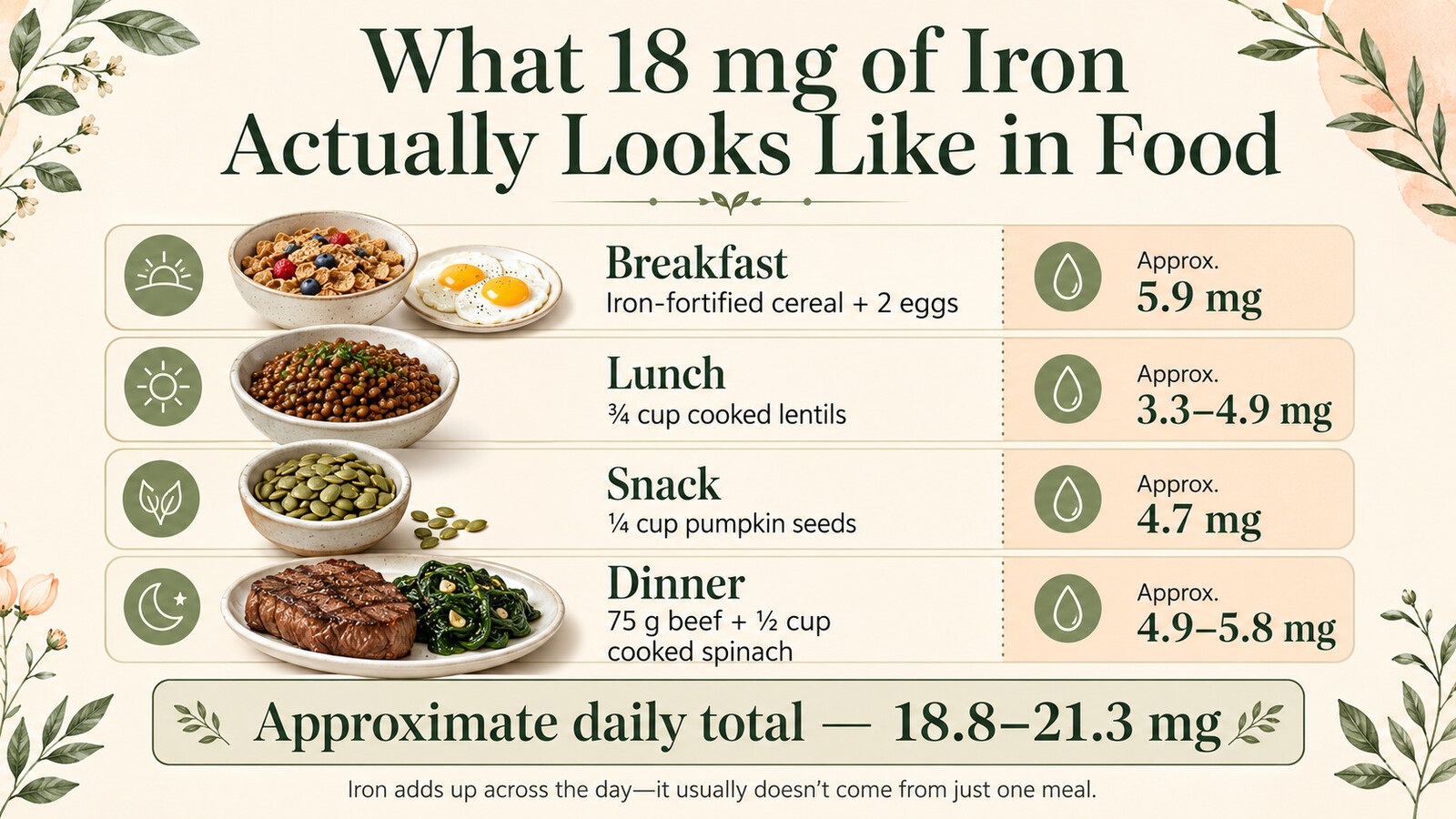
What Does 18 mg of Iron Actually Look Like in Food?
This is the part that often surprises people.
Eighteen milligrams sounds tiny. Yet most everyday foods contain only a few milligrams of iron per serving. Reaching the target usually takes several intentional choices across the day—not one steak, one spinach salad or the occasional bowl of lentil soup.
Here is one realistic example:
| Meal | Food | Approximate iron |
|---|---|---|
| Breakfast | Iron-fortified cereal and 2 eggs | 5.9 mg |
| Lunch | ¾ cup cooked lentils | 3.3–4.9 mg |
| Snack | ¼ cup pumpkin seeds | 4.7 mg |
| Dinner | 75 g beef and ½ cup cooked spinach | 4.9–5.8 mg |
| Approximate daily total | 18.8–21.3 mg | |
You could add berries to breakfast, peppers or tomatoes to the lentils, and a vitamin C-rich vegetable at dinner to support absorption.
This is not a meal plan you need to follow. It is simply a way to make the number visible.
Click to Enlarge
The amounts will also vary by brand, serving size and preparation. Fortified cereals can differ quite a bit, so check the nutrition label on the product you actually use. The food values above are based on common servings listed by HealthLink BC using the Canadian Nutrient File.
If You Are Vegetarian
Know that you generally need to be more intentional about iron.
Health Canada estimates that iron requirements are approximately 1.8 times higher for vegetarians because plant-based iron is less readily absorbed.
That does not mean a vegetarian diet automatically causes low iron. It means regularly including foods such as lentils, beans, tofu, soybeans, pumpkin seeds, tahini and fortified foods—and pairing them with vitamin C—becomes especially important.
Can Food Raise Low Ferritin?
Food is an important foundation. It can help you meet your ongoing needs and support healthy iron stores.
But meeting your daily food target is not the same as treating iron stores that are already depleted.
Ferritin is one of the blood markers used to assess stored iron. If your ferritin is already low, the right next step depends on more than what you ate yesterday.
It may also depend on:
- Why your iron became low
- How depleted your stores are
- Whether blood loss is continuing
- Whether you absorb and tolerate oral iron
- How you have responded to previous treatment
Ferritin is considered the primary diagnostic test for iron deficiency, but the result still needs to be interpreted alongside your symptoms, health history and other relevant bloodwork.
This is the distinction I want women to understand:
Food tells us how much iron you are eating. Bloodwork helps tell us whether your body has enough.
If you have made thoughtful changes to your diet and your iron remains low, that does not mean you have failed.
You may be losing more than food can replace. You may be having difficulty absorbing it. Or you may be starting with stores that require a more targeted treatment plan.
The Bottom Line
So, how much iron does a woman need per day? For most women who menstruate, 18 mg is a useful target. But reaching that amount is not about finding one perfect food. Iron usually adds up through several choices across the day.
- Include intentional iron sources at more than one meal
- Pair plant-based iron with vitamin C
- Be thoughtful about the timing of coffee, tea and calcium supplements
And if your ferritin is already low, your symptoms are continuing or your iron keeps falling, look beyond food alone.
Have Questions About Low Iron? Start With a Conversation
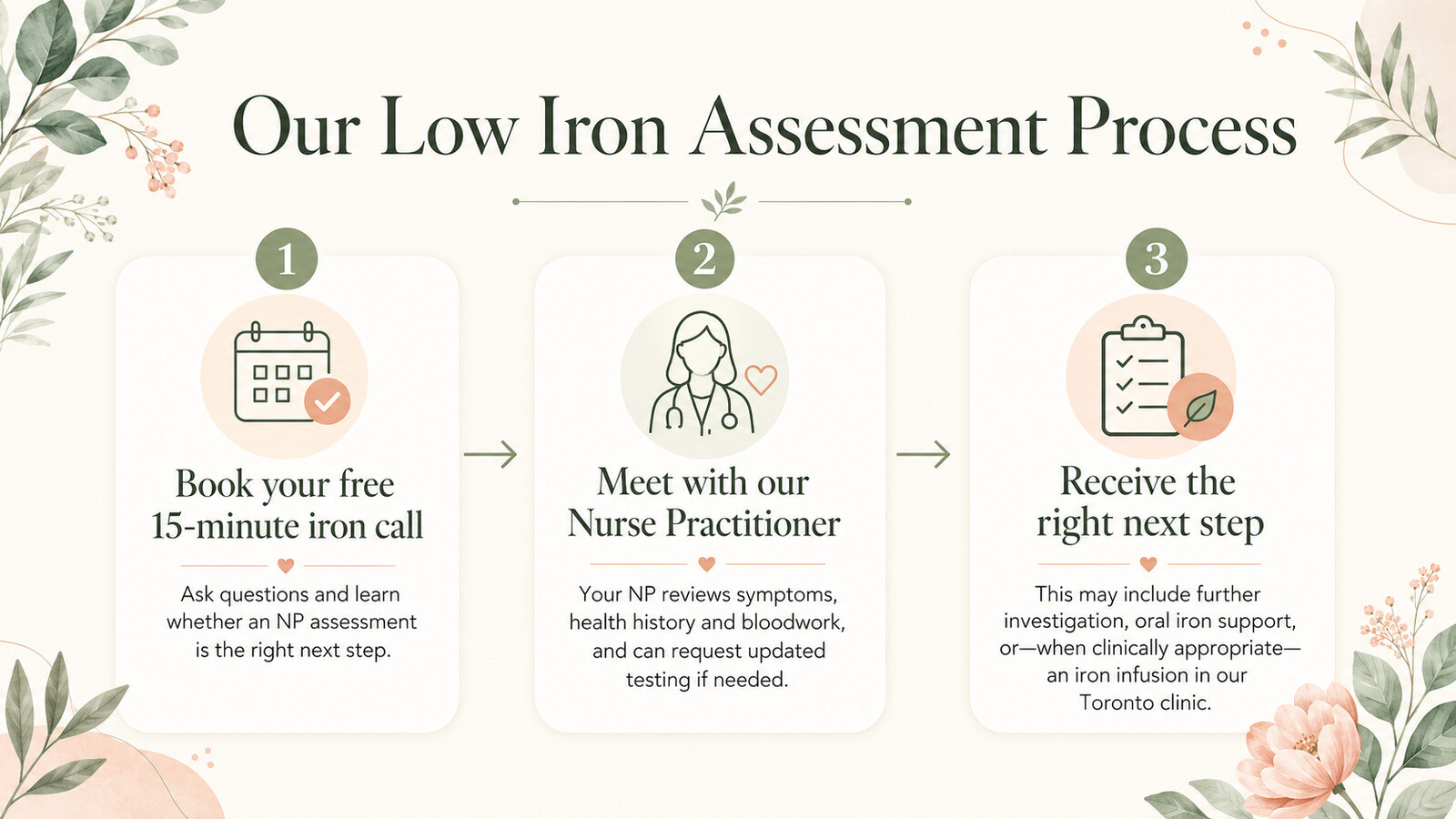
Higher Health’s clinical team includes Nurse Practitioners who assess and treat low iron. The first step is a complimentary 15-minute iron call.
You can tell us what has been happening, ask how our process works and learn whether an NP medical assessment may be the appropriate next step. During the medical assessment, the Nurse Practitioner reviews your symptoms, health history and bloodwork and can request updated testing when needed.
When an iron infusion is clinically appropriate, it can be prescribed by the NP and completed in our monitored Toronto clinic. An infusion is not the right starting point for everyone, which is why the assessment comes first.
Click to Enlarge
The free call is not a commitment to an infusion. It is simply a clear place to start.
Book Your Free 15-Minute Iron Call
Ask your questions. Understand the process. Learn what the right next step may be.
This article is for educational purposes and is not a substitute for individualized medical advice. Do not begin an iron supplement based on symptoms or food calculations alone. Speak with a qualified healthcare provider if you are concerned about low iron, anemia or ongoing symptoms.
References
Last Updated on Wednesday, July 29, 2026
The Vitamin D Conversation I’d Rather Have Now Than in January
Does IV Therapy Work? Here’s When It May Make Sense
Perimenopause and IV Therapy: What the Research Really Shows
