
Most of the women I see who are exhausted have already done the responsible thing.
They went to their doctor.
They had bloodwork.
They were told nothing serious is wrong.
And usually, nothing serious is wrong.
But “nothing serious” and “feeling well” are not the same thing.
That gap is where so many women get stuck.
You wake up tired. You push through the day. You wonder if it is your hormones, your stress, your sleep, your age, or just the season of life you are in right now.
Sometimes those things really do play a role.
But often, there is another piece that gets missed.
For many women, it comes down to one number on a blood test that either does not get checked at all, or gets checked and brushed off because it technically falls “in range.”
That number is ferritin.
Ferritin is your body’s iron storage marker. I often describe it as your body’s iron savings account. And when that savings account gets too low, you can feel exhausted long before you are ever told you have anemia.
This is why low ferritin and fatigue are so often connected, especially in women who have been told their bloodwork looks normal.
The kind of tired that sleep does not fix
You probably know the feeling I am talking about.
It is not the tiredness of one bad night.
It is the tiredness that is still there after a full weekend off.
It is the workout that used to feel manageable, but now wipes you out for two days.
It is rereading the same email three times because the words are not quite landing.
It is feeling cold when everyone else seems fine.
It is hair in the shower drain, brittle nails, headaches that did not used to be there, or standing up too quickly and feeling the room tilt.
And underneath all of it is that quiet, frustrating feeling that you are not really yourself anymore.
A lot of women live in that space for years.
They tell themselves it is just a busy season. They tell themselves they need to sleep more, eat better, work out harder, or manage stress more carefully.
And yes, those things matter.
But if your iron stores are low, no amount of willpower is going to make your cells feel fully energized.
You should not have to live like that.
Low Ferritin and Fatigue: Why You Can Feel Tired Before Anemia Shows Up
When most people hear “iron deficiency,” they think of anemia.
That is the more advanced stage, where your red blood cells and hemoglobin are affected enough to show up clearly on standard bloodwork.
But iron deficiency can start long before that.
Ferritin tells us about your stored iron. And your body relies on iron for far more than most people realize.
Iron helps carry oxygen through your body.
It helps your cells make energy.
It supports thyroid function.
It plays a role in mood, focus, exercise tolerance, and hair growth.
So when your iron stores start running low, the symptoms can show up everywhere.
Your energy.
Your sleep.
Your mood.
Your workouts.
Your focus.
Your patience.
The way your brain feels at 3 p.m.
This is one of the reasons low ferritin symptoms can be so confusing. They do not always look dramatic at first. They often look like “I’m just tired,” “I’m just busy,” or “maybe this is what midlife feels like.”
But it is not in your head.
And it is more common than most women realize.
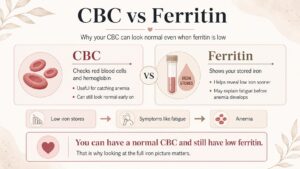
Why your CBC can look normal even when ferritin is low
Here is the part I most want you to understand.
The standard blood test many doctors order is called a CBC. That stands for complete blood count.
A CBC is useful. It can help identify anemia, infection patterns, and other important concerns. But a CBC does not always tell you whether your iron stores are healthy.
You can have a normal hemoglobin level and still have low ferritin.
In plain English, that means your bloodwork can look “fine” while your iron savings account is running low.
This is one reason so many women are told their bloodwork is normal, even though they are tired, foggy, cold, lightheaded, losing hair, or struggling to get through the day.
Their red blood cells may not be showing anemia yet.
But their iron stores may already be depleted.
That is the difference between looking only for anemia and looking at the full iron picture.
This is one of the most common reasons low ferritin and fatigue get missed.
What ferritin level is considered low?
This is where things can get confusing.
Many labs only flag ferritin when it drops below the lab’s reference range. But a reference range does not always tell the full story of how you feel.
Ferritin below 30 is commonly used as a marker of iron deficiency. Some research on unexplained fatigue in non-anemic women has looked at ferritin levels below 50, because symptoms can appear before a woman is officially anemic.
That does not mean every woman needs the same ferritin level.
It means ferritin should not be interpreted in isolation.
At Higher Health, we look at the full picture:
- Your symptoms.
- Your CBC.
- Your ferritin.
- Your serum iron.
- Your TIBC.
- Your transferrin saturation.
- Your menstrual history.
- Your digestion.
- Your thyroid.
- Your inflammation markers when needed.
- Your health history as a whole.
Because the goal is not just to chase a number.
The goal is to understand whether low iron stores are one of the reasons you do not feel like yourself.
Low ferritin symptoms women often miss
Low ferritin does not always feel like one obvious thing.
For some women, it feels like heavy exhaustion.
For others, it feels like poor recovery, brain fog, anxiety-like feelings, low mood, headaches, dizziness, cold hands and feet, hair shedding, restless legs, shortness of breath with exercise, or a general sense that their body does not have the same stamina it used to.
Some women can still function. They can still work, parent, exercise, and get through the day.
But everything takes more effort.
That is often the clue.
Not that you cannot function.
But that functioning now feels like pushing a boulder uphill.
“My bloodwork is normal, but I’m still tired”
If you have ever been told your bloodwork is normal but you still feel exhausted, I want you to know something:
That does not mean nothing is going on.
It may simply mean the right markers were not checked, or the results were not interpreted in the context of your symptoms.
This is especially true with iron.
A CBC can be normal while ferritin is low.
Ferritin can technically be “in range” while still not being ideal for how you feel.
And if only one iron marker was checked, you may not be seeing the full pattern.
That is why I rarely look at one number by itself.
Your body is not a single lab value. It is a full story.
And when someone takes the time to read that story properly, things often start to make more sense.
What blood tests to ask for if you suspect low ferritin
If this is sounding familiar, here is what I would want you to ask about at your next appointment.
You can say:
“I would like to look at my full iron picture, not just my CBC. Could we add ferritin and a full iron panel?”
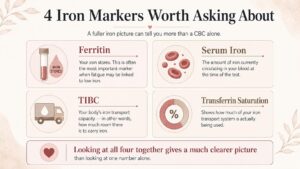
The iron markers worth asking about include:
Ferritin
This is your iron storage marker. It is often the most important number when we are looking at low ferritin and fatigue.
Serum iron
This shows the amount of iron currently circulating in your blood.
TIBC
This stands for total iron-binding capacity. It helps show how much capacity your body has to transport iron.
Transferrin saturation
This helps show how much of your iron transport system is actually being used.
Looking at these markers together is much more useful than looking at one number alone.
Most doctors will say yes when you ask directly.
Low ferritin vs. iron deficiency anemia
This distinction matters.
Iron deficiency anemia means your iron deficiency has progressed far enough to affect your hemoglobin or red blood cells.
Low ferritin means your stored iron may be low, even if your hemoglobin has not dropped yet.
That earlier stage is often called iron deficiency without anemia.
And it can still matter.
Iron deficiency without anemia is increasingly recognized as clinically relevant because symptoms like fatigue, poor concentration, and reduced exercise tolerance can appear before classic anemia is diagnosed.
This is why it can be so frustrating for women.
They are not “sick enough” to be flagged.
But they also do not feel well.
That middle zone deserves attention.
“But I already tried iron and it didn’t work”
I hear this all the time.
A woman tells me she tried iron supplements for a few weeks, felt awful, did not notice much improvement, and gave up.
That does not always mean iron was not part of the issue.
It often means the approach was not right yet.
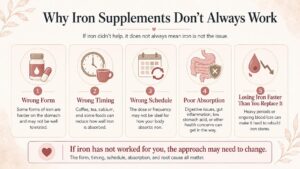
Here are a few common reasons iron supplements do not work well.
The form may be wrong
Some of the cheapest and most common iron supplements can be hard on the stomach.
They may cause constipation, nausea, cramping, or digestive discomfort.
Other forms may be better tolerated for some people, but the best choice depends on the person, their labs, their digestion, and their health history.
The timing may be wrong
Iron does not absorb well with everything.
Coffee, tea, calcium, dairy, and some supplements can interfere with absorption.
A lot of women take iron with breakfast, coffee, or their other vitamins and end up absorbing much less than they think.
The schedule may be wrong
More is not always better.
Research has shown that alternate-day iron dosing can improve absorption in some women because of how iron affects hepcidin, a hormone involved in regulating iron absorption.
That does not mean every person should take iron every other day. It means the schedule should be thoughtful, not random.
Something may be blocking absorption
Low stomach acid, gut inflammation, undiagnosed celiac disease, certain medications, thyroid issues, or other digestive concerns can all interfere with iron absorption.
If your body cannot absorb the iron properly, taking more of it may not solve the problem.
You may be losing iron faster than you can replace it
Heavy periods are one of the most common reasons women struggle with low iron stores.
If you are losing a lot of blood every month, oral iron may not be enough to rebuild your stores quickly.
This is why the full picture matters.
We do not just ask, “Is ferritin low?”
We ask, “Why is it low, why is it not improving, and what is the most appropriate way to help restore it?”

When IV iron may be considered for low ferritin
For some women, getting iron levels back up takes more than oral supplements.
IV iron may be considered when iron stores are very depleted, when oral iron has not worked, when supplements are not tolerated, when absorption is an issue, or when ongoing blood loss is making it hard to catch up.
An IV iron infusion bypasses the gut and allows iron to be delivered directly into the bloodstream.
It is not the first step for everyone.
But for the right person, under proper medical assessment, it can be an important option.
At Higher Health, we run full iron panels, not just a CBC. We look at your symptoms, your history, your bloodwork, and whether oral iron, further investigation, or IV iron may be appropriate.
The goal is never just to push a lab number into range.
The goal is to understand what your body is telling us and help you move toward feeling like yourself again.
You deserve more than “in range”
This is what I want you to take with you.
Being exhausted all the time is not just part of being a busy woman.
It is not automatically hormones.
It is not automatically stress.
And it is not something you should have to push through forever.
Your tiredness is information.
So is the brain fog.
So is feeling cold.
So is the hair shedding.
So is the dizziness when you stand up.
So is the way your workouts suddenly feel harder than they used to.
Your body may be trying to tell you something.
Sometimes the answer is low ferritin.
Sometimes it is something else.
But the answer almost always becomes clearer when someone takes the time to look at the full picture.
You do not have to keep guessing.
And you do not have to settle for “in range” when you do not feel well.
Dr. Tara Campbell, ND, is the founder of Higher Health Naturopathic Centre & IV Lounge in Toronto. She works with women who are tired of being tired and ready to understand what their body has been trying to tell them.
If low ferritin and fatigue sound like your story, the next step is not guessing — it is looking at the full iron picture.
If you are in Ontario, book a free 15-minute call with our team. We can talk through your symptoms, your history, whether updated bloodwork may be helpful, and what your next step could look like.
Book your free 15-minute call here.
You can also read more about how our iron infusion in Toronto works, including who it is appropriate for and what to expect during an appointment.
The clinical guidance in this article reflects current research on iron deficiency, ferritin, iron deficiency without anemia, fatigue in women, and oral iron absorption. Research reviews recognize that iron deficiency can cause symptoms even without anemia, ferritin below 30 is commonly used as a marker of iron deficiency, and some fatigue studies in non-anemic women have evaluated ferritin below 50. Evidence also suggests that alternate-day oral iron dosing may improve absorption in some women.
This article is for educational purposes only and is not a substitute for individualized medical advice. If you are concerned about iron deficiency, low ferritin, anemia, or persistent fatigue, please consult with a qualified healthcare provider.
References
- Al-Naseem A, Sallam A, Choudhury S, Thachil J. Iron deficiency without anaemia: a diagnosis that matters. Clinical Medicine (London). 2021;21(2):107–113.
- Vaucher P, Druais PL, Waldvogel S, Favrat B. Effect of iron supplementation on fatigue in nonanemic menstruating women with low ferritin. CMAJ. 2012.
- Jäger L, et al. Ferritin Cutoffs and Diagnosis of Iron Deficiency in Primary Care. JAMA Network Open. 2024.
- Stoffel NU, et al. Iron absorption from supplements is greater with alternate day than with consecutive day dosing in iron-deficient anemic women. Haematologica. 2020.
- Sholzberg M, et al. Diagnosis and management of iron deficiency in females. CMAJ. 2025.
Last Updated on Monday, July 20, 2026
Why Am I Suddenly So Achy? Could It Be Perimenopause?
The Vitamin D Conversation I’d Rather Have Now Than in January
Does IV Therapy Work? Here’s When It May Make Sense
